When navigating emotional trauma, chronic stress, or nervous exhaustion, choosing between Lepidolite v Kunzite places you at the crossroads of nature’s two most powerful lithium-bearing minerals. While both stones share an enchanting pastel palette tinted by trace manganese, they approach emotional equilibrium and heart-centred healing through fundamentally different geochemical structures and energetic frequencies.
Lepidolite, a delicate, layered sheet silicate (phyllosilicate), functions as an emotional sedative. Rich in natural lithium and potassium, its soft, micaceous sheets act as a bio-energetic buffer, down-regulating a hyperactive sympathetic nervous system, arresting cyclical worry loops, and calming somatic panic held in the chest. It creates a tranquil container that allows an overstimulated mind to surrender into rest.
In contrast, Kunzite—the pink-to-violet gem variety of spodumene—is a dense, rigid single-chain silicate (inosilicate). Packing a higher concentration of elemental lithium into an anhydrous framework, kunzite operates as an energetic conduit. Rather than merely soothing tension, its directional prismatic lattice penetrates deep emotional armouring, dissolving old heartaches, grief, and defensiveness to restore vulnerability and unconditional love.
Whether you need the cool, stabilising embrace of lilac mica to halt bedtime rumination or the radiant, high-frequency beam of spodumene to heal a wounded heart, understanding the mineral science and metaphysical dynamics of each stone ensures you select the precise ally for your journey.
Technical & Gemological Comparison Matrix
| Diagnostic Property | Lepidolite | Kunzite (Spodumene) |
| Mineral Classification | Phyllosilicate (Mica Group) | Inosilicate (Pyroxene Group) |
| Chemical Formula | $\text{K(Li,Al)}_3\text{(Al,Si,Rb)}_4\text{O}_{10}\text{(F,OH)}_2$ | $\text{LiAlSi}_2\text{O}_6$ |
| Crystal System | Monoclinic ($2/m$) | Monoclinic ($2/m$) |
| Structural Architecture | Continuous 2D sheets ($\text{Si}_4\text{O}_{10}$ layers) | Infinite 1D single chains ($\text{Si}_2\text{O}_6$ chains) |
| Mohs Hardness | 2.5 to 3.5 (Soft, flexible, sectile) | 6.5 to 7.0 (Hard, brittle) |
| Cleavage | $\{001\}$ Perfect basal (peels into elastic folia) | $\{110\}$ Perfect prismatic at $\sim 87^\circ$ and $93^\circ$ |
| Fracture | Uneven, micaceous tearing | Splintery to uneven, fragile |
| Specific Gravity | 2.80 – 2.90 | 3.16 – 3.20 |
| Refractive Index | $n = 1.525 – 1.587$ (Low double refraction) | $n = 1.655 – 1.677$ (Birefringence $0.014 – 0.027$) |
| Optical Phenomenon | Pearly sheen along cleavage faces | Extreme, vivid pleochroism (trichroic) |
| Water Safety | Strictly Water-Unsafe (Delaminates) | Water-Safe for short rinses (Avoid thermal shock) |
| Light Sensitivity | Stable; resistant to fading | Strongly Photosensitive (Fades to clear in sunlight) |
Geochemistry & Lithium Concentration: Phyllosilicate vs Inosilicate
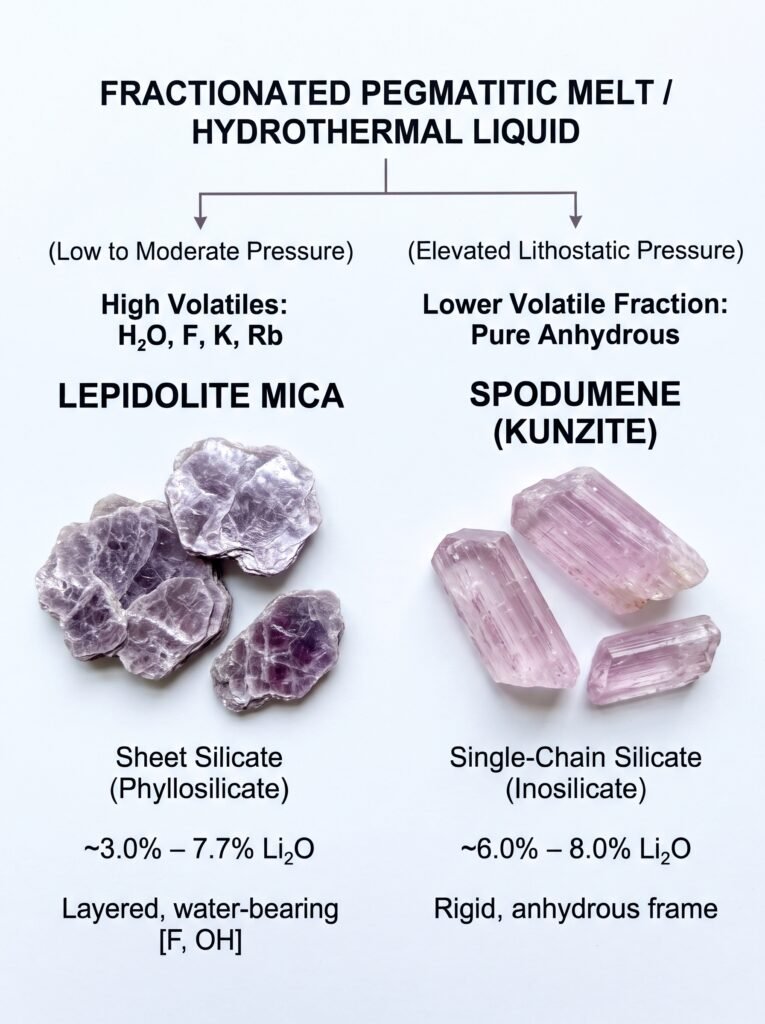
Both minerals require highly evolved, hyper-fractionated LCT (Lithium-Caesium-Tantalum) granitic pegmatites to form. In these late-magmatic systems, incompatible elements are squeezed into remaining hydrothermal pockets, but the way lithium bonds in each crystal lattice differs fundamentally.
The Inosilicate Framework of Kunzite
Spodumene is a single-chain inosilicate. Pairs of corner-sharing $[\text{SiO}_4]^{4-}$ tetrahedra link into infinite parallel chains running parallel to the c-axis:
$$[\text{Si}_2\text{O}_6]^{4-}$$
These chains are cross-linked laterally by alternating lithium ($\text{Li}^+$) and aluminium ($\text{Al}^{3+}$) ions coordinated in octahedral sites.
Because the crystal lattice excludes large alkali cations (such as potassium and rubidium) and contains no structural hydroxyl groups or fluorine, it packs tightly. Spodumene boasts higher structural density ($\sim 3.18\text{ g/cm}^3$) and a consistently higher baseline lithium oxide concentration ($6.0\%$ to $8.0\%$ $\text{Li}_2\text{O}$) than lepidolite, making it the premier global ore for commercial lithium extraction.
The Phyllosilicate Framework of Lepidolite
As explored in our Lepidolite Lithium Science Deep Dive, lepidolite belongs to the mica family. Tetrahedral $[\text{SiO}_4]$ and $[\text{AlO}_4]$ groups extend outwards in continuous two-dimensional sheets:
$$[\text{Si}_4\text{O}_{10}]^{4-}$$
Between pairs of these sheets lies an octahedral sheet where $\text{Li}^+$ and $\text{Al}^{3+}$ reside, capped by fluorine ($\text{F}^-$) and hydroxyl ($\text{OH}^-$) ions. These stacked sandwich structures are pinned together by large, weakly bonded potassium ($\text{K}^+$) or rubidium ($\text{Rb}^+$) cations.
Consequently, lepidolite has lower lithium density ($3.0\%$ to $7.7\%$ $\text{Li}_2\text{O}$), lower specific gravity ($\sim 2.85\text{ g/cm}^3$), and an elastic, yielding structure that fractures along flat basal planes rather than along crystallographic prisms.
Structural Mechanics & Optical Anomalies
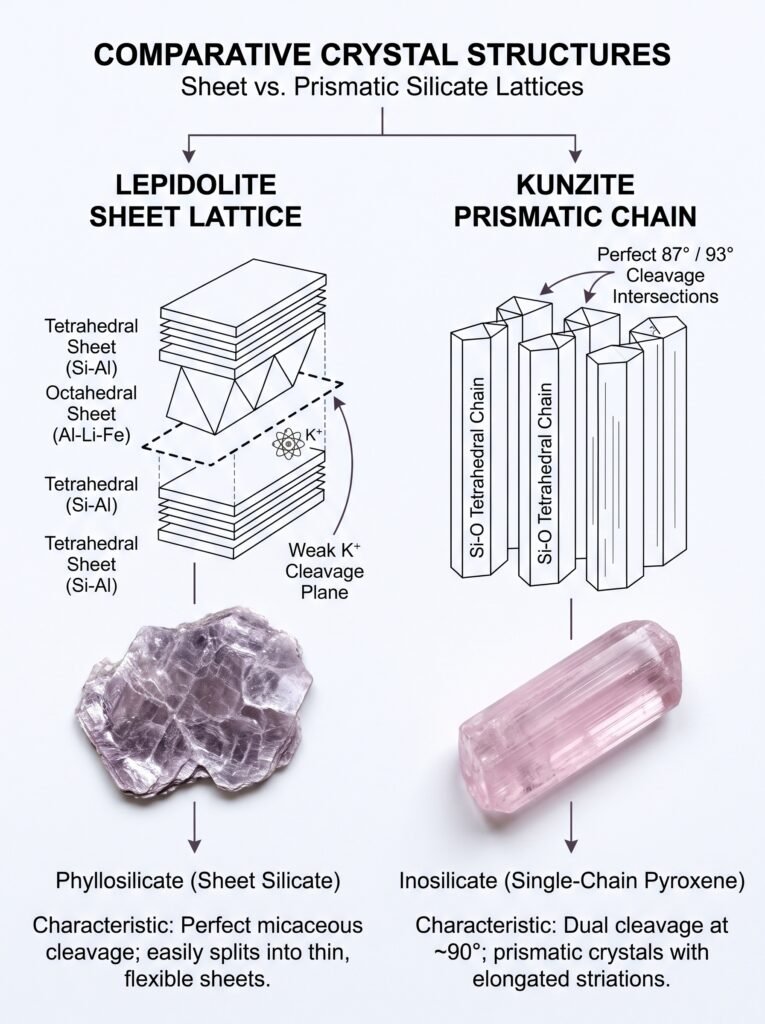
Cleavage & Tenacity: Basal Peeling vs Prismatic Splintering
- Lepidolite Cleavage: Exhibits $\{001\}$ perfect basal cleavage. Because bonding within the sheets is strong, but bonding between the sheets is exceptionally weak (ionic potassium bonds), the mineral peels into thin, elastic laminae. It absorbs mechanical shocks by flexing and shedding flakes, but is easily scratched with a copper coin (Mohs 2.5–3.5).
- Kunzite Cleavage: Exhibits $\{110\}$ perfect prismatic cleavage intersecting at roughly $87^\circ$ and $93^\circ$. While kunzite is significantly harder than lepidolite (Mohs 6.5–7.0), its internal chain bonds are vulnerable to parallel shearing. A sharp blow or thermal shock splits kunzite along its vertical prism faces, creating sharp, splintery breaks. Lapidaries must cut kunzite with extreme care to avoid shattering the rough.
Chromophore Chemistry & Pleochroism
Both minerals derive their pink-to-violet coloration from trace impurities of trivalent manganese ($\text{Mn}^{3+}$) substituting into octahedral coordination sites. However, the optical expression is starkly distinct:
- Lepidolite Lustre: Generally opaque to translucent, displaying a silvery, pearly schiller on freshly cleaved basal faces due to interlamellar reflection.
- Kunzite Trichroism: Exhibits dramatic optical pleochroism. When viewing a high-grade kunzite crystal down its long c-axis, it exhibits intense magenta-violet. Viewed perpendicular to the c-axis through its prism faces, the colour pales to soft lilac or washes out into near-colourless transparency.
Cautionary Conservation Note: The $\text{Mn}^{3+}$ colour centres in kunzite are unstable under ultraviolet light. Prolonged exposure to direct sunlight or strong display halogen lighting will photochemically reduce $\text{Mn}^{3+}$ to divalent $\text{Mn}^{2+}$, bleaching a vivid pink gemstone into a dull, colourless crystal over time. Lepidolite does not suffer this severe UV bleaching.
Heart Healing & Energetic Mechanics: Sedation vs Illumination
In metaphysical lithotherapy, both stones are linked to emotional restoration, but they address the heart chakra (Anahata) from opposing energetic polarities.
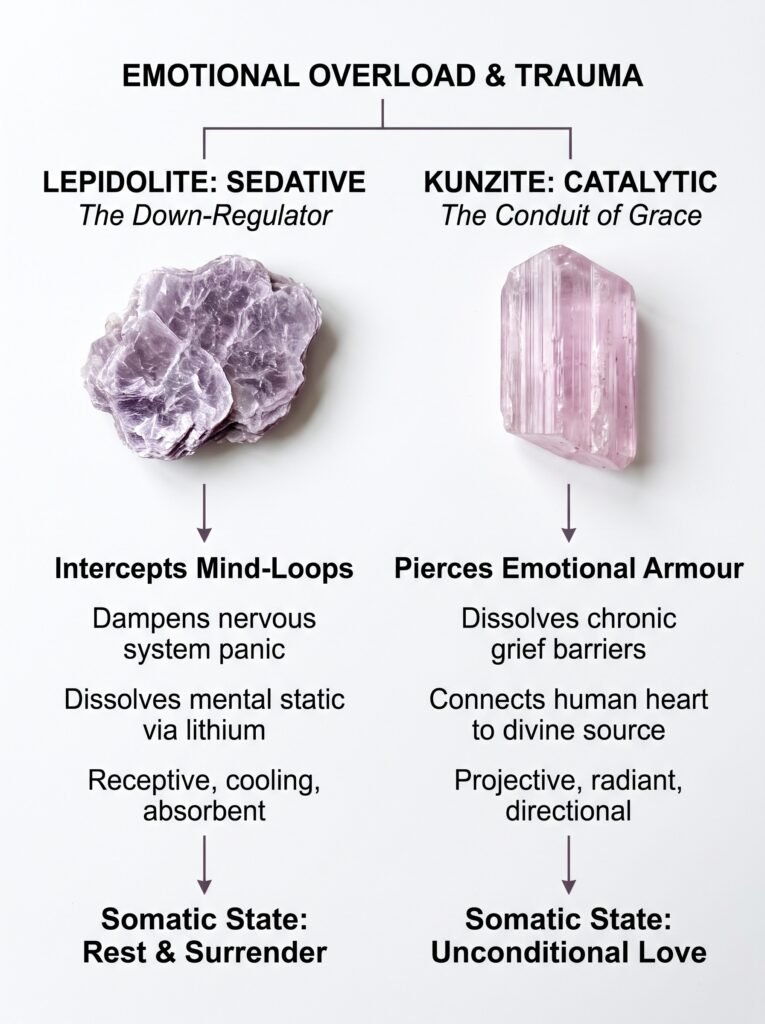
Lepidolite: The Receptive Sedative (Down-Regulation)
Lepidolite works as a cosmic sponge and parasympathetic regulator. It is the stone to deploy when emotional distress has caused mental hyper-vigilance, manic rumination, and somatic anxiety.
- Primary Mechanism: Receptive, cooling, and absorbing.
- Chakra Axis: Bridges the Heart (Anahata) with the Third Eye (Ajna) and Crown (Sahasrara).
- Therapeutic Application: Lepidolite intercepts runaway stress loops. It creates a tranquil containment zone around an agitated chest, settling a racing pulse and soothing feelings of acute panic. It does not force emotional processing; rather, it creates the quiet neurological space needed for recovery.
Kunzite: The Projective Conduit (High-Frequency Activation)
Kunzite functions as a focused beam of high-vibrational emotional illumination. It is the stone to deploy when the heart has become calcified, closed off, cynical, or insulated by defensive armouring following severe heartbreak or chronic betrayal.
- Primary Mechanism: Projective, penetrating, and expansive.
- Chakra Axis: Bridges the Heart (Anahata) directly with the Throat (Vishuddha) and Crown (Sahasrara).
- Therapeutic Application: Kunzite clears long-held emotional blockages. Because its crystal structure consists of directional inosilicate chains, it channels energy longitudinally through the auric field. It dissolves lingering sorrow, instils an intuitive sense of safety, and reconnects isolated individuals to universal, unconditional love.
Selecting the Right Stone for the Practitioner
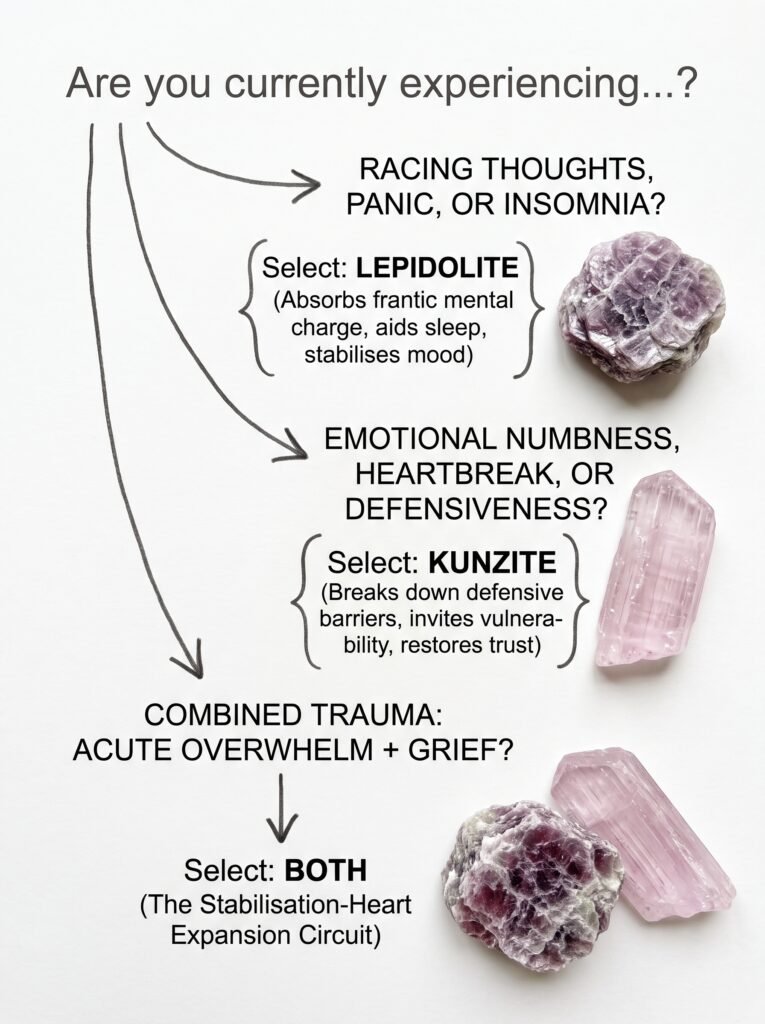
Choose Lepidolite If:
- Your emotional distress manifests physically as tension headaches, a knotted stomach, or an inability to slow your breathing.
- You suffer from bedtime rumination, catastrophic future-projecting, or insomnia (see our guide on Lepidolite vs Amethyst for Sleep).
- You need an affordable, durable palm stone for tactile sensory grounding throughout the working day (explore our Anxiety Protocol for Lepidolite).
Choose Kunzite If:
- You feel emotionally numb, disconnected from empathy, or unable to let down protective walls in relationships.
- You are actively processing unresolved childhood grief, divorce, or deep romantic loss and are ready to clear that energetic density.
- You are doing focused heart-chakra meditation and wish to channel higher spiritual awareness down into your emotional centre.
Synergy Protocols: The “Restored Sanctuary” Circuit
When paired intentionally, lepidolite and kunzite establish an exceptional emotional healing dynamic: kunzite opens and elevates the heart, while lepidolite grounds the nervous system to prevent emotional whiplash.
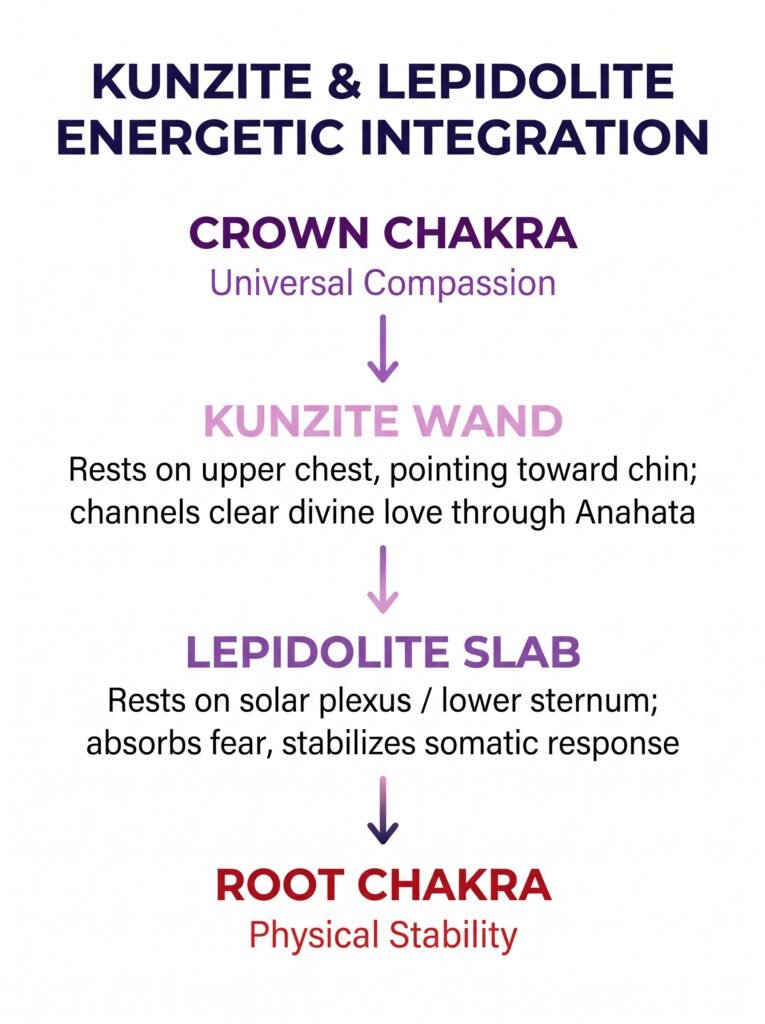
Step-by-Step Layout for Emotional Release
- Prepare the Space: Lie comfortably on your back in a dimly lit room away from direct sunlight (to protect your kunzite from UV degradation). Ensure you have no water near your minerals.
- Position the Lepidolite: Rest a polished, flat lepidolite palm stone directly over your solar plexus (just below your ribcage). This serves as your nervous system’s energetic heat sink.
- Position the Kunzite: Place a kunzite crystal over the centre of your sternum (Heart Chakra), aligning its natural striations vertically along the length of your spine.
- The Breath Bridge: Inhale for a count of four, drawing kunzite’s pink light into the centre of your chest. Hold for four counts. Exhale for seven counts, feeling any panic or resistance flow downward into the lepidolite for neutralisation.
- Closure: Continue for 10 to 15 minutes. Remove the kunzite first, followed by the lepidolite. Ground yourself by placing your bare feet flat on the floor.
Physical Care, Cleansing, and Longevity
| Care Vector | Lepidolite Protocol | Kunzite (Spodumene) Protocol |
| Water Exposure | Strictly Prohibited. Water infiltrates basal sheets, causing delamination and structural decay. | Permitted for brief cool rinses. Never use boiling water or steam cleaners (risks thermal cracking). |
| Sunlight Exposure | Safe. Resists solar fading; retains lilac hue under normal ambient light. | Strictly Prohibited. Prolonged UV exposure permanently bleaches kunzite into colourless spodumene. |
| Mechanical Risk | Soft (2.5–3.5 Mohs). Easily scratched by keys, quartz, or metal jewellery. | Brittle with perfect prismatic cleavage. Easily cleaves or chips along prism edges if dropped. |
| Safe Cleansing | Dry sound therapy (432 Hz bowls), full moonlight, or dry Selenite charging plates. | Overnight moonlight, sound cleansing, or gentle smoke clearing with cedar/sage. |
Related Content & In-Depth Guides
- The Ultimate Guide to Lepidolite: Geology, Lithium Science & Metaphysical Power
- Lepidolite Lithium Science & Benefits: Geochemistry & Metaphysical Resonance
- Pink Tourmaline in Lepidolite: Geology, Extraction, and Heart-Chakra Healing
- How to Use Lepidolite for Anxiety: Nervous System Regulation, Placement & Rituals
- Can Lepidolite Go in Water? Complete Cleansing, Safety, and Mineral Care Guide