When demystifying the intersection of mineralogy and emotional wellness, Lepidolite Lithium Science reveals a fascinating bridge between deep geological formation and human nervous system regulation. Widely celebrated as the quintessential “stone of transition,” this lilac-hued mica carries one of nature’s highest natural concentrations of elemental lithium. Yet, popular metaphysical lore often misunderstands the actual biochemical physics at play, mistakenly conflating tactile crystal work with pharmaceutical pharmacology.
Formed within highly evolved granitic pegmatites, lepidolite is a complex potassium-lithium-aluminum phyllosilicate with a distinctly stratified sheet structure. Unlike synthetic pharmacological lithium salts that dissolve readily in gastric acid to cross the blood-brain barrier, the lithium within lepidolite is bound securely inside an insoluble aluminosilicate crystal lattice. It does not leach into the bloodstream through transdermal skin contact, nor should it ever be ingested in water elixirs due to toxic trace elements like fluorine.
Instead, the profound calming properties of lepidolite operate through neuro-somatic and bio-electrical channels. Its low thermal conductivity, delicate micaceous cleavage, and cooling surface activate key skin mechanoreceptors—such as Merkel cells and Ruffini endings—directly signaling the vagus nerve to upregulate parasympathetic tone and pull the body out of chronic fight-or-flight stress loops.
By separating geochemical reality from commercial myth, we can appreciate lepidolite for what it genuinely is: an extraordinary natural semiconductor and somatic anchor engineered by the earth to ground restless mental energy and restore emotional equilibrium.
The Geochemistry of Lithium in Phyllosilicates
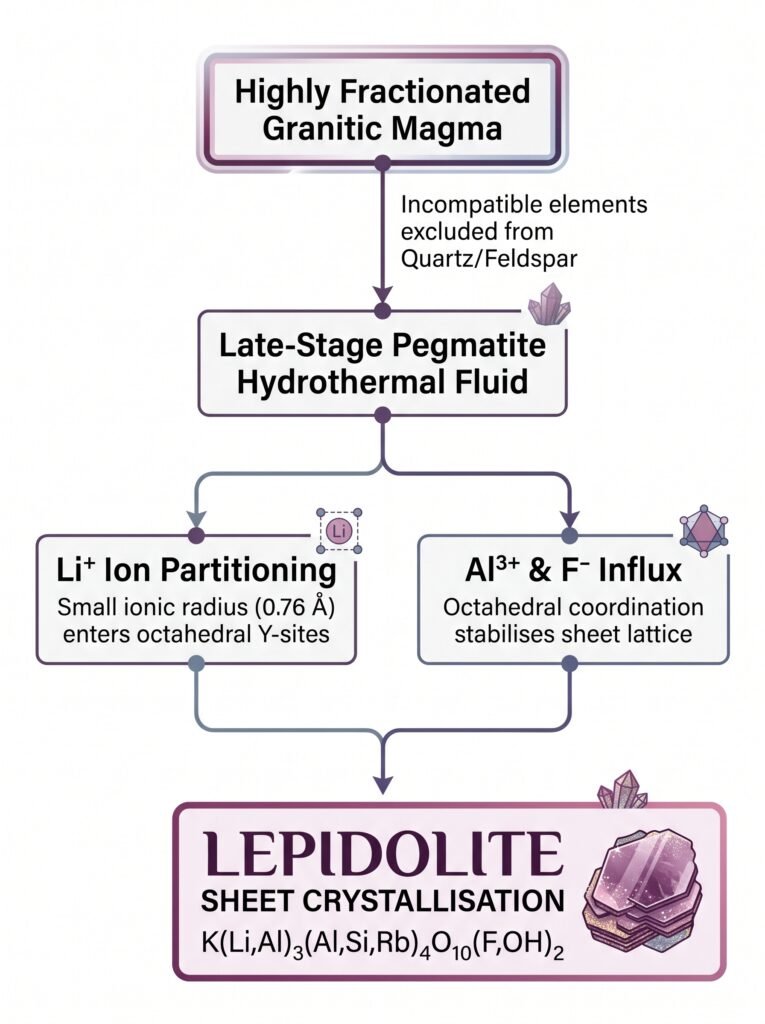
The Pegmatite Concentration Engine
Lithium is an inherently incompatible element during early magmatic differentiation. Because of its tiny ionic radius ($0.76\text{ \AA}$) and low positive charge ($+1$), it cannot easily substitute into early-forming rock-forming minerals like olivine, pyroxene, or calcic plagioclase.
Instead, lithium remains dissolved in residual, highly volatile-enriched fluids within cooling granitic intrusions. When these fluids inject into host rock fractures to form LCT (Lithium-Caesium-Tantalum) pegmatites, lithium finally nucleates into specialised lithium minerals: spodumene (a pyroxene), petalite (a tectosilicate), and lepidolite (a phyllosilicate mica).
Mineral Chemistry & The Polylithionite–Trilithionite Series
Mineralogically, “lepidolite” is a series name representing an unbroken solid-solution series between two distinct end-members rather than a single static formula:
- Trilithionite: $\text{KLi}_{1.5}\text{Al}_{1.5}(\text{Si}_3\text{Al})\text{O}_{10}\text{F}_2$
- Polylithionite: $\text{KLi}_2\text{Al}(\text{Si}_4\text{O}_{10})\text{F}_2$
The generalised industrial formula is standardly written as:
$$\text{K(Li,Al)}_3\text{(Al,Si,Rb)}_4\text{O}_{10}\text{(F,OH)}_2$$
Weight Percentage of Lithium in Lepidolite
In geological deposits, the lithium content of commercial lepidolite typically ranges between $3.0\%$ and $7.7\%$ $\text{Li}_2\text{O}$ (lithium oxide) by weight (translating to roughly $1.4\%$ to $3.6\%$ pure elemental lithium). While spodumene generally exhibits higher thermal stability for battery extraction, lepidolite deposits in Zimbabwe (Bikita), Canada (Tanco), Namibia (Karibib), and China (Yichun) represent massive global strategic reserves of lithium and rare alkali metals like rubidium ($\text{Rb}$) and caesium ($\text{Cs}$).
Structural Layering: Why Mica “Flexes” Under Stress
The unique physical properties of lepidolite—its flaky texture, elasticity, and peeling “books”—stem from its TOT (Tetrahedral-Octahedral-Tetrahedral) sheet architecture:
- The Lithium-Bearing Octahedral Layer: The central sheet of the TOT sandwich contains octahedral sites occupied by $\text{Al}^{3+}$ and $\text{Li}^+$. Because lithium has a lower valence ($+1$) than the aluminium ($+3$) it replaces, this substitution creates a localised charge deficit that is balanced by fluorine ($\text{F}^-$) substituting for hydroxyl ($\text{OH}^-$) groups, and interlamellar potassium ($\text{K}^+$).
- Weak Potassium/Rubidium Interlayers: The completed TOT sandwiches stack on top of one another, held together only by large, electrostatically weak alkali cations ($\text{K}^+$, $\text{Rb}^+$).
- Perfect Basal Cleavage $\{001\}$: Because the bonds within the TOT sandwich are strong covalent/ionic links, but the bonds between sandwiches are exceptionally weak, lepidolite easily cleaves into paper-thin, flexible sheets. This structural design explains why lepidolite yields under mechanical friction, absorbing impact rather than shattering rigidly like quartz.
The Pharmacology of Lithium vs Raw Crystalline Mineral
To safely and responsibly apply lepidolite, one must understand how pharmacology intersects with natural mineralogy:
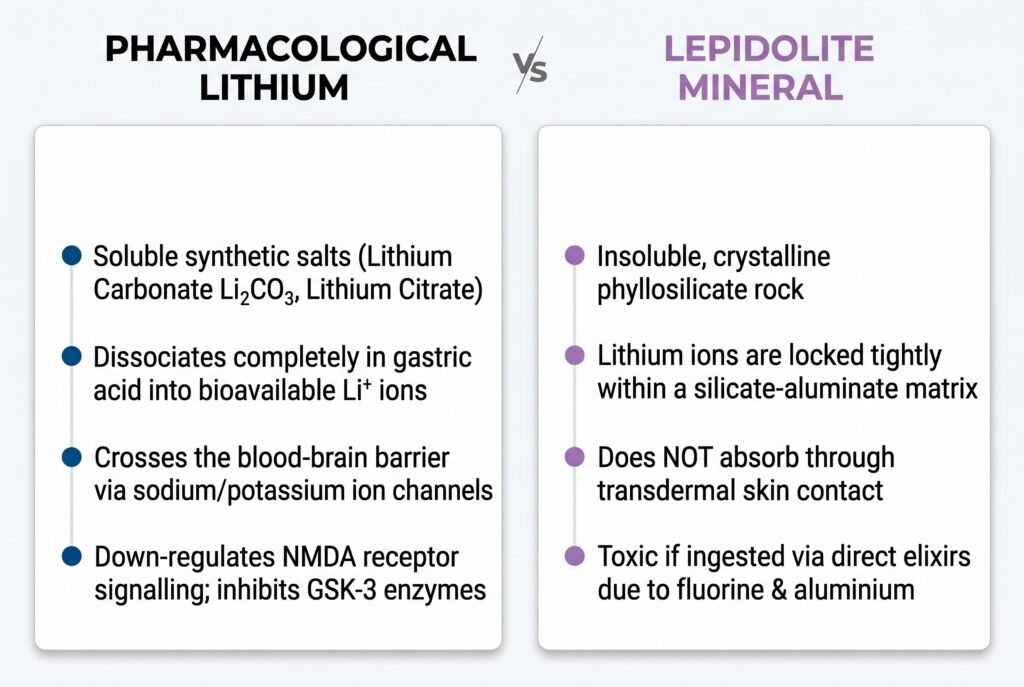
Neurobiology: How Soluble Lithium Works in the Brain
In medicine, psychiatric lithium carbonate ($\text{Li}_2\text{CO}_3$) acts as a gold standard mood stabiliser:
- Glycogen Synthase Kinase-3 (GSK-3) Inhibition: Lithium inhibits GSK-3, an enzyme that, when hyperactive, promotes neuronal apoptosis, cellular stress, and emotional volatility.
- Inositol Monophosphatase Depletion: It down-regulates the phosphatidylinositol second-messenger cascade, dampening excessive excitatory neurotransmission (glutamate).
- Neuroplasticity Promotion: It up-regulates brain-derived neurotrophic factor (BDNF), physically protecting hippocampal volume and calming erratic autonomic nervous system arousal.
The Mineral Reality: What Lepidolite Does (and Cannot) Do
A common misconception in amateur crystal communities is that holding a piece of lepidolite allows the body to “absorb lithium through the pores.”
From a biochemical standpoint, skin absorption of lithium from a dry, solid silicate mineral does not occur. The lithium cations are securely locked within the crystalline aluminosilicate sheets by strong chemical bonds. Furthermore, attempting to release these ions by soaking lepidolite in water creates a genuine health hazard: the mineral will not only degrade along its cleavage planes, but it can leach toxic trace fluorides ($\text{F}^-$) and aluminium ($\text{Al}^{3+}$).
- Direct Elixir Warning: Never drink water in which lepidolite has been submerged. Always use the indirect method (placing the dry crystal inside a sealed, dry glass container, which is then set into the water vessel) if preparing gem essences.
The Metaphysical-Scientific Synthesis: Vibrational Transduction
If lithium does not enter the bloodstream transdermally, how does lepidolite function so effectively in energetic and somatic therapies? The answer lies in vibrational resonance, tactile neuro-grounding, and piezoelectric dissipation.
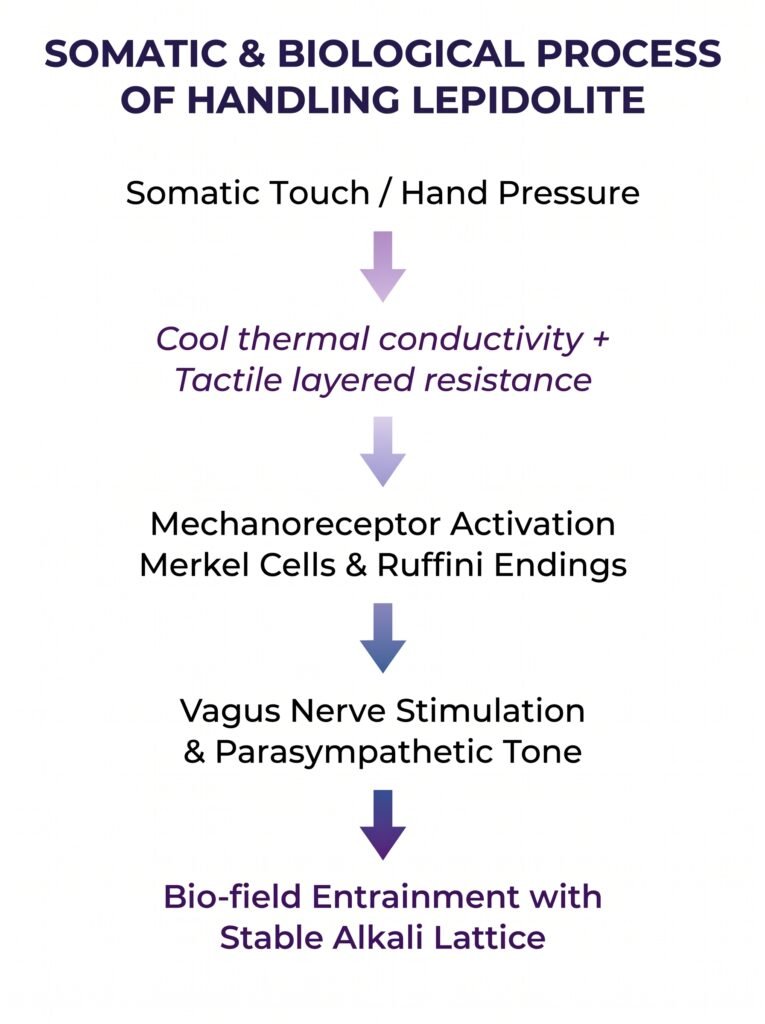
1. Tactile Thermal Feedback & Parasympathetic Anchoring
Lepidolite possesses a uniquely low thermal conductivity compared to dense quartz minerals, paired with a soft, slightly yielding texture (Mohs 2.5–3.5). When an individual experiencing acute anxiety holds a polished lepidolite palm stone, the specific sensory input from the layered mica stimulates slow-adapting cutaneous mechanoreceptors. This sensory feedback diverts neural bandwidth away from the panic-generating amygdala, resetting vagal tone.
2. High-Frequency Alkali Field Buffering
In esoteric science, minerals act as energetic crystalline resonators. Lithium is the lightest solid metal on the periodic table—an alkali element with extreme electrochemical reactivity. Within lepidolite, this volatile, hyper-reactive element is completely stabilised and bound by cooling silica sheets.
Metaphysically, this mirrors its psychological action: it takes erratic, hyper-reactive, chaotic energy (the unbonded lithium state) and binds it within a structured, tranquil matrix (the silicated sheet structure).
3. The Manganese Chromophore Synergy
Lepidolite’s lilac and violet hue is caused by trivalent manganese ($\text{Mn}^{3+}$) substituting for aluminium in the crystal lattice. In vibrational colour therapy, violet occupies the highest frequency of the visible spectrum ($380–450\text{ nm}$), which corresponds to the Third Eye and Crown chakras. When combined with the grounding, dense presence of rubidium and caesium, lepidolite achieves an energetic polarity: it opens higher mental faculties while keeping the autonomic nervous system anchored.
Technical Comparison: Lithium Minerals in Geology & Metaphysics
Lepidolite is not the only lithium mineral. Understanding its counterparts contextualises why it is uniquely preferred for nervous system work:
| Mineral | Crystal Family | Chemistry | Li2O Content | Physical Energy Signature |
| Lepidolite | Phyllosilicate (Mica) | $\text{K(Li,Al)}_3(\text{Al,Si})_4\text{O}_{10}(\text{F,OH})_2$ | $\sim 3.0\% – 7.7\%$ | Sedative & Absorbent: Soft sheets down-regulate mental panic and emotional loops. |
| Spodumene (Kunzite / Hiddenite) | Inosilicate (Pyroxene) | $\text{LiAlSi}_2\text{O}_6$ | $\sim 6.0\% – 8.0\%$ | Directional & Dynamic: Prismatic chains channel high-voltage heart awakening and active healing. |
| Petalite | Tectosilicate (Feldspathoid-like) | $\text{LiAlSi}_4\text{O}_{10}$ | $\sim 3.5\% – 4.5\%$ | Ethereal & Expansive: Lightweight framework connects to transpersonal, angelic, and cosmic frequencies. |
| Amblygonite | Phosphate | $\text{(Li,Na)AlPO}_4(\text{F,OH})$ | $\sim 7.0\% – 10.0\%$ | Catalytic & Focused: Phosphorus framework activates creative drive and clarifies personal will. |
Practical Application: Bridging Mind and Mineral
To harness the scientifically informed metaphysical benefits of lepidolite without falling into pseudoscience:
- Acknowledge the Mechanism: Treat lepidolite as a biofield stabiliser and a tactile neuro-grounding tool, not a transdermal pharmaceutical tablet.
- Deploy for Pattern Interruption: Keep a polished specimen near your workstation to interrupt obsessive problem-solving loops. When mental fatigue peaks, handle the stone for two minutes, focusing exclusively on its layered, cold cleavage planes.
- Preserve the Mineral Matrix: Respect its delicate $\{001\}$ cleavage and avoid water submersion. Cleanse using sound frequencies (tuning forks or bowls) to preserve the integrity of the lithium-bearing mica layers.
Related Guides & In-Depth Resources
- The Ultimate Guide to Lepidolite: Geology, Lithium Science & Metaphysical Power
- How to Use Lepidolite for Anxiety: Nervous System Regulation, Placement & Rituals
- Lepidolite vs Amethyst: Differences in Geology, Energy, and Sleep Support
- Can Lepidolite Go in Water? Complete Cleansing, Safety, and Mineral Care Guide