Prized for its dark monzonite matrix and striking silvery-blue schiller, Larvikite is an exceptional stone that bridges ancient geological history with potent metaphysical grounding. However, maintaining its deep lustre and structural integrity requires an intentional approach to daily handling. This comprehensive Larvikite Care Guide provides the practical, science-backed protocols necessary to protect your specimens and jewellery from physical abrasions, chemical damage, and environmental wear.
Sitting between 6.0 and 6.5 on the Mohs hardness scale with two planes of perfect cleavage, Larvikite possesses unique physical vulnerabilities that everyday mineral collectors and jewellery enthusiasts often overlook. In this guide, you will learn the exact cleaning methods to preserve its reflective flash, critical warnings regarding ultrasonic and steam cleaners, safe storage solutions, and the most harmonious crystal pairings to enhance its grounding energy while avoiding discordant combinations.
Physical Mechanics & Mohs Hardness Safety
To handle and preserve Larvikite without causing surface abrasion or structural failure, one must evaluate its two primary physical properties: hardness and cleavage.
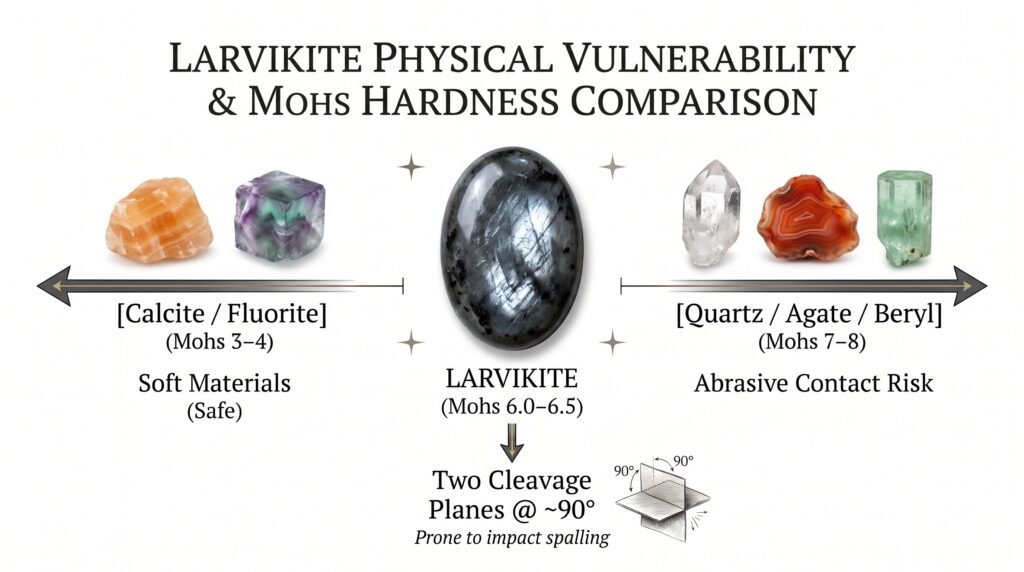
The Mohs 6.0 – 6.5 Boundary
Larvikite sits at 6.0 to 6.5 on the Mohs scale of mineral hardness, dictated primarily by its ternary alkali feldspar content (anorthoclase, orthoclase, and albite).
- The Quartz Dust Hazard: Common airborne household and workshop dust contains microscopic particles of quartz (Mohs 7.0). Wiping a dry, dusty Larvikite specimen with a tissue or dry rag drags quartz grit across its surface, cutting micro-scratches into the mirror polish. Over time, this cumulative abrasion dulls the stone’s reflective schiller.
- Storage Isolation: Never store polished Larvikite loose in a container alongside harder minerals such as Quartz, Amethyst, Agate, Topaz, or Corundum. Contact during transit will leave noticeable surface gouges. Always house Larvikite specimens in individual soft pouches or compartmented, foam-lined display boxes.
Cleavage Vulnerability
Like all feldspar-dominated rocks, Larvikite possesses two directions of perfect cleavage intersecting near 90 degrees. While the interlocking crystalline texture of plutonic monzonite makes it tougher than a single crystal of orthoclase, sharp mechanical impacts—such as dropping a palm stone onto a tiled floor or knocking a ring against a hard surface—can trigger spalling or delamination along these natural cleavage planes.
Larvikite Care Guide
Preserving the surface lustre of Larvikite requires strict chemical discipline. While more resilient to environmental exposure than calcite- or copper-based minerals, its feldspar and accessory silicate matrix can be compromised by reactive chemicals.
| Substance / Solution | Safety Profile | Mechanism of Damage |
| Lukewarm Fresh Water | Safe | Perfectly safe for short rinses and manual washing under 60 seconds. |
| Saline / Salt Water | Hazardous | Micro-fissures absorb brine; recrystallising salt forces micro-lamellae apart. |
| Household Acids (Vinegar, Lemon) | Damaging | Weak acids attack accessory apatite and dull the polished feldspar face. |
| Bleach & Ammonia | Prohibited | Destroys optical coatings, strips polishes, and damages jewellery mountings. |
| Ultrasonic / Steam Baths | Destructive | High-frequency cavitation and thermal shock split internal cryptoperthite layers. |
The Salt Water Hazard
Never immerse Larvikite in salt water or leave it buried in dry rock salt for energetic cleansing. The stone’s crystalline boundaries contain microscopic surface-reaching pores and cleavage traces. Brine readily enters these fissures; as moisture evaporates, salt recrystallises and expands, generating internal pressure that can spall the surface and permanently strip its reflective flash.
Cleaning Protocol
- Rinse: Run under lukewarm, fresh tap water for 30–60 seconds to float away loose surface dust.
- Wash: Apply a few drops of pH-neutral, fragrance-free soap using your bare fingertips or an ultra-soft natural-bristle brush.
- Dry: Pat gently with a clean, lint-free microfibre cloth. Allow the piece to air-dry completely in a shaded area before storage.
Physical & Lapidary Synergies: Setting and Workshop Compatibility
When incorporating Larvikite into lapidary projects, wire-wrapping, or fine jewellery mountings, its physical characteristics dictate how it should be set and worn.
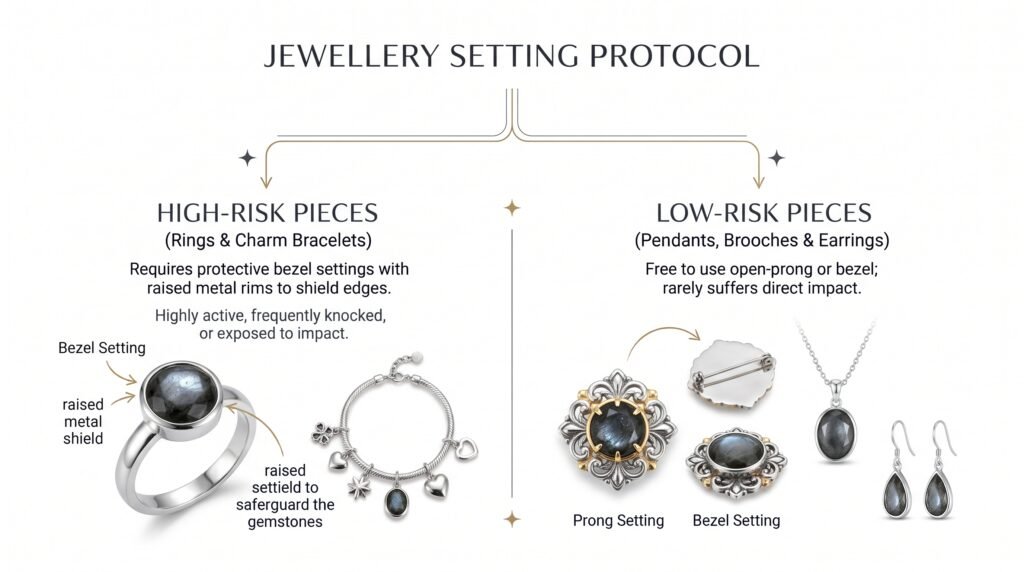
- Setting Selection: For everyday rings or bracelets, use protective bezel settings rather than open prong mounts. A smooth metal bezel wraps around the perimeter of the stone, shielding its vulnerable 90° cleavage edges from accidental knocks.
- Lapidary Polishing Compounds: When refining or re-polishing dull Larvikite cabochons, finish with cerium oxide or high-grade aluminium oxide on a soft leather or felt lap with copious water lubrication. Avoid excessive dry friction, which generates localised heat and can cause thermal cracking across the feldspar grain boundaries.
Storage and Daily Maintenance Checklist
- Separate Pouches: Keep Larvikite pieces in individual microfibre or velvet pouches to prevent contact with quartz-family stones.
- Dry Storage: Ensure specimens are completely dry before storing them in sealed boxes to prevent moisture accumulation around metallic accessory minerals (such as magnetite).
- Chemical Shielding: Put on your Larvikite jewellery after applying cosmetics, perfumes, hairsprays, and lotions.
- Manual Removal: Take off rings and bracelets prior to dish washing, swimming, exercising, or handling household cleaning solutions.