
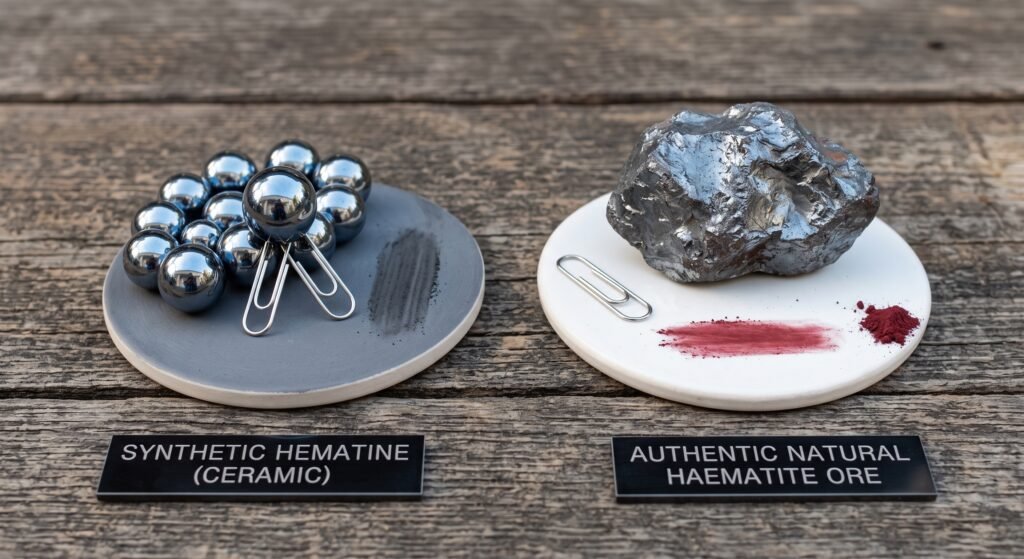
If you have ever purchased a heavy, mirror-bright metallic bracelet at a tourist gift shop or wellness market that snaps aggressively to refrigerator doors, chances are you do not own haematite. Instead, you hold an entirely synthetic ceramic compound known in the trade as hematine, hemalyke, or simply “magnetic hematite.”
While both materials share a sleek, gunmetal-grey polish, they belong to fundamentally different worlds. Natural haematite is an ancient iron oxide forged through billions of years of sedimentary, hydrothermal, and volcanic processes. Hematine, by contrast, is an industrial, lab-pressed ceramic ferrite developed in the mid-20th century.
Understanding how to tell these two apart protects buyers from inflated prices, mislabelled specimens, and misleading metaphysical claims.
Quick Comparison: At a Glance
| Feature | Authentic Natural Haematite | Synthetic “Hematine” / Hemalyke |
| Origin | Natural mineral ore ($\text{Fe}_2\text{O}_3$) | Reconstituted barium-strontium ferrite ceramic |
| Magnetic Pull | None to extremely weak (antiferromagnetic) | Strong, permanent attraction (acts as a magnet) |
| Streak Test | Cherry-red to reddish-brown | Dark grey to jet black |
| Density (SG) | Very heavy: $4.9 – 5.3$ | Moderately heavy: roughly $4.0 – 4.5$ |
| Lustre & Surface | Deep metallic or sub-metallic; may show micro-pits | Flawless, mirror-chrome, glassy reflection |
| Edge Translucency | Microscopic thin flakes can show deep blood-red | Completely opaque under intense backlighting |
What Exactly Is “Hematine”?
Hematine frequently marketed under brand names like Hemalyke or Magnetic Hematite is not crushed haematite re-melted into beads. It is a manufactured ceramic ferrite composed primarily of barium oxide or strontium oxide blended with ferric oxide:
$$\text{BaFe}_{12}\text{O}_{19} \quad \text{or} \quad \text{SrFe}_{12}\text{O}_{19}$$
The raw powders are milled, pressed into moulds under extreme hydraulic pressure, and sintered (fired) at high temperatures in industrial kilns. Once shaped and cooled, the material is passed through an electromagnetic field to magnetise it, creating a permanently magnetic ceramic that costs pennies to produce at scale.
While hematine makes durable, inexpensive, and visually striking fashion jewellery, selling it as natural gemstone material borders on consumer deception when retailers omit its synthetic origin. For more information on Haematite see my post Haematite (Hematite) Stone: Meaning, Properties & History
Why Real Haematite Is NOT Naturally Strongly Magnetic
One of the most persistent misconceptions in the lapidary world is that because haematite is an iron ore, it must naturally attract metal. In mineralogy, iron content does not automatically confer permanent magnetism.
- Antiferromagnetic Alignment: At room temperature, haematite ($\alpha\text{-Fe}_2\text{O}_3$) exhibits a canted antiferromagnetic structure. Its internal magnetic dipoles largely cancel each other out, giving it only a minute magnetic susceptibility.
- The Refrigerator Test: A natural tumbled haematite stone will not snap onto a steel knife, hold itself against a refrigerator door, or lift steel paperclips.
- Magnetite vs Haematite: The only common iron oxide mineral that naturally exhibits strong, noticeable magnetic pull is magnetite ($\text{Fe}_3\text{O}_4$), specifically its naturally magnetised variety known as lodestone.
The Rule of Thumb: If your “hematite” beads pull toward each other with an audible snap or hold themselves suspended from a steel surface, they are 100% synthetic hematine.
4 Definitive Tests to Identify Real vs Fake
Before adding a piece to your collection or crafting jewellery, you can run four straightforward diagnostic checks:
1. The Magnet Attraction Test
- Procedure: Bring your specimen near an iron paperclip or a flat steel surface.
- The Verdict: Real haematite shows zero noticeable attraction. If the stone actively jumps toward the metal or suspends itself, it is hematine.
2. The Unfired Porcelain Streak Test
- Procedure: Take the underside of an unglazed ceramic tile or the rough bottom rim of a standard ceramic coffee mug. Firmly drag the edge of your specimen across the surface.
- The Verdict: Real haematite will leave a distinctive cherry-red to reddish-brown line (its signature “blood” mark). Synthetic hematine will leave a dark grey, charcoal, or black streak.
3. Weight and Specific Gravity
- Procedure: Hold an authentic tumbled pebble of jasper or quartz of identical size in one hand and your test specimen in the other.
- The Verdict: Natural haematite possesses a specific gravity of roughly $5.0$ to $5.3$—it feels cold, surprisingly dense, and heavy in the palm. Hematine, while heavier than plastic, is noticeably less dense ($4.0$ to $4.5$) and feels lighter than raw iron ore.
4. Surface Texture and Fractures
- Procedure: Inspect the drill holes, edges, and surface under a $10\times$ jeweller’s loupe.
- The Verdict: Natural haematite rarely takes an immaculate, mirror-like finish across an entire batch of beads without minute crystalline fissures, soft metallic pitting, or subtle grey-black colour zoning. Hematine features a smooth, liquid-like, uniform chrome surface with cleanly pressed, identical edges.
Metaphysical & Healing Implications
For crystal practitioners and holistic workers, the distinction between these two materials is critical:
- Natural Haematite: Valued for grounding, shielding, and connecting directly to the Earth’s tectonic energy and the Root Chakra. Its organic geological lineage carries the vibrational history of ancient mineral formation.
- Hematine: Because it is an industrial ceramic created through electrical sintering, it lacks natural crystalline growth matrices. While its physical magnetic field can offer mild sensory stimulation or tactile engagement during stress relief, it does not carry the geological resonance of natural earth-formed minerals.
Buyer’s Checklist: How to Avoid Getting Caught Out
When purchasing haematite online, at gem shows, or from wholesale lapidary suppliers:
- Watch Out for the Word “Magnetic”: Any listing boasting “Magnetic Rainbow Hematite” or “Magnetic Healing Hematite” is selling synthetic ceramic ferrite.
- Beware the “Rainbow” Sheen on Beads: Iridescent, petroleum-sheen hematite beads are almost always vapour coated hematine. While natural iridescent haematite does exist (turgite), it is an expensive, delicate collector’s mineral that is rarely, if ever, cut into cheap commercial beads.
- Check Price Points: Carving solid, high-grade natural haematite into perfect spheres without shattering requires skilled lapidary work. A 16-inch strand of perfectly uniform, highly polished beads selling for £2 or $3 is synthetic ferrite.
- Demand Clear Disclosure: Reputable mineral and lapidary dealers explicitly separate authentic tumbled haematite from reconstituted magnetic jewellery novelties. Always ask for the streak test result if you are unsure.
