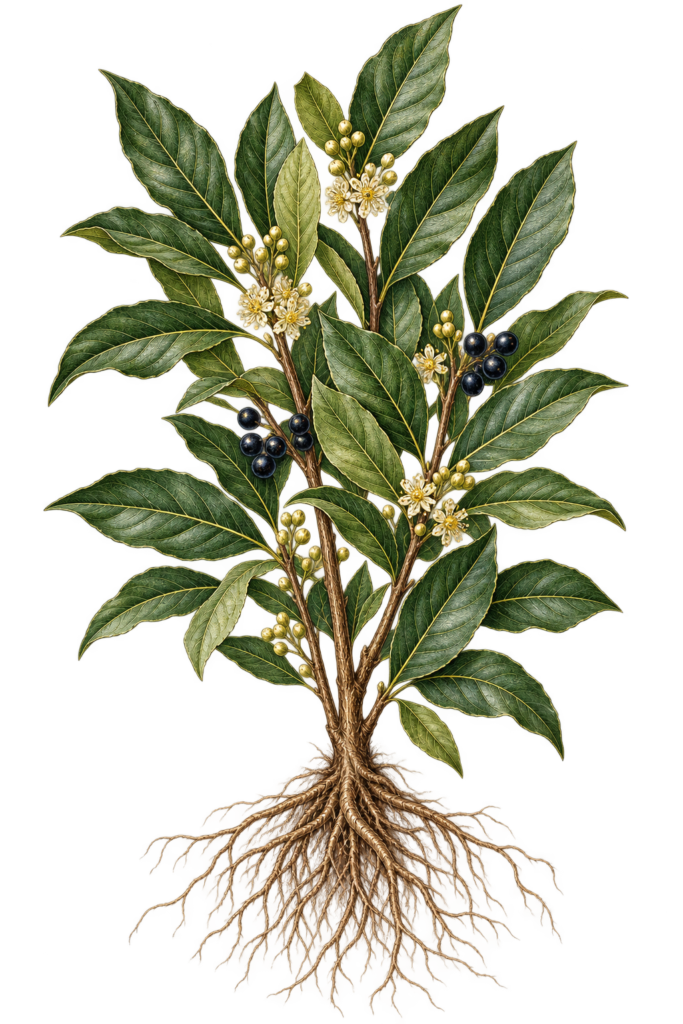
Laurus nobilis, commonly known as bay laurel, sweet bay, or true laurel, is an aromatic evergreen shrub or small tree belonging to the family Lauraceae. Native to the Mediterranean Basin, it typically grows between 7 to 18 meters tall in the wild, though it is frequently kept pruned in domestic gardens.
Morphology: The leaves are alternate, glabrous (smooth), coriaceous (leathery), and lanceolate to oblong, measuring 6–12 cm in length and 2–4 cm in width with finely serrated, wavy margins.
Flowers & Fruit: It is a dioecious species (male and female flowers appear on separate plants). The small, pale yellow-green flowers bloom in pairs or clusters beside the leaf axils during spring, giving way on female plants to small, shiny, one-seeded black or deep-purple berries roughly 1 cm long.
Key Species & Culinary Distinctions:
Mediterranean Sweet Bay (Laurus nobilis): The culinary gold standard. Subtle, herbal, woody, with notes of eucalyptus and pine.
California Bay (Umbellularia californica): Known as Oregon myrtle or pepperwood. Far more pungent with high concentrations of umbellulone; used sparingly as a culinary substitute.
Indian Bay Leaf (Cinnamon tamala / Tejpatta): From the cinnamon family. Olive-green with three prominent longitudinal veins; exhibits an aroma profile closer to cassia and clove rather than Mediterranean laurel.
West Indian Bay (Pimenta racemosa): Belonging to the myrtle family (Myrtaceae), this species is distilled for classic bay rum aftershaves and colognes rather than cooking.
Toxic Lookalikes: Never confuse culinary bay with Mountain Laurel (Kalmia latifolia) or Cherry Laurel (Prunus laurocerasus), both of which contain lethal toxins (such as cyanogenic glycosides and grayanotoxins).
Ancient Origins & Antiquity
The cultural history of Laurus nobilis is anchored in classical Greco-Roman mythology and civic life.
- The Myth of Daphne and Apollo: According to Ovid’s Metamorphoses, the nymph Daphne prayed to her river-god father, Peneus, to escape the relentless pursuit of Apollo. She was transformed into a laurel tree. Heartbroken, Apollo declared the laurel forever sacred, vowing to wear its leaves in his hair, adorn his lyre with its branches, and grant eternal youth to its evergreen leaves.
- The Pythian Games: Celebrated at Delphi in honour of Apollo, victors of athletic, poetic, and musical competitions were crowned with wreaths of bay laurel (corona triumphalis), inaugurating the association between laurel and supreme achievement.
- The Delphic Oracle: The Pythia (the high priestess at the Temple of Apollo) was said to chew or burn bay leaves to induce prophetic trances and facilitate communion with the sun god.
- Imperial Rome: Roman emperors, generals celebrating a triumph, and distinguished poets were adorned with laurel crowns. Julius Caesar famously wore a laurel wreath, which served both as a symbol of military dominance and, according to Suetonius, a way to cover his thinning hair.
Folklore, Superstition & Cultural Traditions
Beyond official state ceremonies, laurel embedded itself into European folklore as a powerful protective and omen-bearing plant.
- Protection from Lightning: Both Pliny the Elder and the Roman Emperor Tiberius believed laurel trees were immune to lightning strikes. Tiberius was known to don a laurel wreath during thunderstorms for protection.
- Omens of Decline and Death: Because of its evergreen resilience, a withering bay tree was viewed across the Mediterranean and Renaissance England as an omen of death, disaster, or the downfall of a ruling monarch (a superstition immortalised in Shakespeare’s Richard II: “Tis thought the king is dead; we will not stay. The bay-trees in our country are all wither’d”).
- Daphnomancy (Divination by Laurel): A classic form of divination involved casting dry bay leaves into a fire. If the leaves crackled loudly as they burned, it signalled good fortune, prosperity, and the favour of the gods; if they burned silently without a sound, it was considered a grave omen.
- Love & Dream Folklore: Placing dried bay leaves beneath one’s pillow on St. Valentine’s Eve or Halloween was traditionally believed to induce prophetic dreams of a future spouse.
Therapeutic & Medicinal Applications
Modern phytochemistry validates many traditional uses of Laurus nobilis, driven primarily by its rich essential oil profile containing 1,8-cineole (eucalyptol), eugenol, linalool, alpha-pinene, and sabinene.
- Digestive Support: Bay leaf infusions stimulate gastric juices, ease flatulence, and help relieve abdominal cramps through carminative and antispasmodic actions.
- Anti-Inflammatory & Analgesic: The presence of eugenol and sesquiterpene lactones (such as costunolide) helps downregulate inflammatory pathways. Topically diluted laurel essential oil has historically been rubbed on arthritic joints and sore muscles.
- Respiratory Aid: High levels of 1,8-cineole make bay leaf steam inhalations an effective expectorant for clearing congested airways, loosening phlegm, and easing bronchial irritation.
- Antimicrobial & Antioxidant: Extracts exhibit broad-spectrum antibacterial and antifungal activity against common foodborne pathogens and skin microbes, while polyphenols and flavonoids scavenge oxidative free radicals.
- Blood Sugar & Lipid Regulation: Several preliminary clinical studies suggest regular consumption of ground bay leaf (1–3 g/day) may help improve insulin sensitivity and improve HDL-to-LDL cholesterol ratios in individuals with type 2 diabetes.
Astrological and Mystical Correspondences
| Category | Correspondence | Esoteric Context |
| Planetary Ruler | Sun ($\odot$) | Governs vitality, radiant success, solar clarity, authority, and health |
| Elemental Alignment | Fire ($\Delta$) | Active, purifying, transformative, catalytic, and illuminating |
| Zodiac Sign | Leo ($\♌$) | Associated with leadership, nobility, honor, and expressive power |
| Chakra Association | Solar Plexus (3rd) & Third Eye (6th) | Willpower, personal sovereignty, intuition, and psychic vision |
| Polarity / Gender | Masculine / Yang | Projective, protective, assertive energy |
| Deities | Apollo, Daphne, Ra, Helios, Brigid | Solar deities, patrons of poetry, truth, healing, and prophecy |
Culinary & Domestic Uses
Bay leaf acts as an aromatic foundation in classical culinary traditions around the world. Unlike pungent finishing herbs, bay leaves provide a slow-release, background depth that ties disparate flavours together.
- The Backbone of Stocks and Sauces: A foundational component of the French bouquet garni (along with thyme and parsley), bay leaf adds subtle bitterness, camphoraceous warmth, and woodsy herbal notes to stocks, stews, braises, and tomato sauces.
- Starch and Dairy Infusions: Steeping a bay leaf in milk creates the aromatic base for classic Béchamel sauce, bread sauce, or custards. Dropping a leaf into boiling rice, lentils, or beans cuts starchiness and imparts a delicate aroma.
- Whole vs. Ground: Whole leaves are predominantly used during prolonged simmering and discarded before serving due to their sharp, leathery edges. Ground bay leaf is concentrated and must be used sparingly.
- Domestic Pest Deterrent: Due to volatile compounds like cineole and alpha-pinene, dried bay leaves are a classic household remedy placed in flour bins, pantries, and grain containers to repel flour weevils, moths, and cockroaches.
Spiritual, Energetic & Metaphysical Properties
In modern energetic and metaphysical practices, bay leaf is celebrated as a multi-purpose herb for manifestation, space clearing, and psychic shielding.
- Bay Leaf Manifestation Burning: One of the most widespread folk rituals involves writing an intention, wish, or financial goal directly onto a broad, dried bay leaf with ink, visualising the outcome, and safely burning the leaf in a heat-proof vessel to release the energy into the universe.
- Banishing & Space Clearing: Smouldering bay leaves produce a crisp, herbaceous smoke traditionally used to cleanse stagnant or negative energies from homes, reset mental clarity, and clear mental fatigue.
- Warding & Protection: Hanging a branch of bay above entryways or placing whole leaves at the four corners of a room serves as a protective perimeter against psychic intrusion and malice.
- Lucid Dreaming & Intuition: Placing bay leaves inside a sachet under your pillow or meditating near bay smoke before sleep is said to thin the veil between conscious thought and intuitive inner visions.
Fun Facts
- The Etymology of “Baccalaureate”: The term baccalaureate (and by extension, bachelor’s degree) traces back to the Latin bacca lauri (“laurel berry”), referencing the ancient practice of crowning scholars and accomplished students with laurel berries and leaves.
- “Poet Laureate”: The prestigious title of “Poet Laureate” awarded by governments and royal houses stems directly from the Greco-Roman tradition of crowning celebrated poets with laurel wreaths.
- “Resting on Your Laurels”: This common idiom—meaning to rely on past achievements rather than continuing to work hard—originates from ancient Greek athletes and Roman military commanders who, having won their laurel crowns, retired from active effort.
- Aleppo Soap Heritage: The ancient Syrian city of Aleppo has produced soap for millennia using olive oil combined with varying concentrations (up to 40%) of pressed laurel berry oil (Laurus nobilis), famous for its purifying and skin-soothing properties.
Frequently Asked Questions
Why shouldn’t you eat the whole bay leaf in a dish?
Not necessarily. Fresh leaves can be overwhelmingly bitter, medicinal, and pungent due to high concentrations of volatile oils. As the leaf dries, bitter notes fade, leaving behind a balanced, complex aroma of tea, sweet wood, and menthol.
Are fresh bay leaves better than dried ones?
Not necessarily. Fresh leaves can be overwhelmingly bitter, medicinal, and pungent due to high concentrations of volatile oils. As the leaf dries, bitter notes fade, leaving behind a balanced, complex aroma of tea, sweet wood, and menthol.
Can I grow Laurus nobilis at home?
Yes. Bay laurel thrives in well-draining soil with full to partial sun. It grows slowly, making it an ideal container plant that can be overwintered indoors in cooler zones (it is hardy in USDA zones 8–10, but struggles with prolonged freezing temperatures).
How do I tell if my stored dried bay leaves are still good?
Bend and lightly crush a leaf. If it retains a pale olive-green hue and releases a fragrant, sweet herbal aroma immediately upon cracking, it is good to use. If it is dull brown and produces no scent, the volatile essential oils have evaporated.