
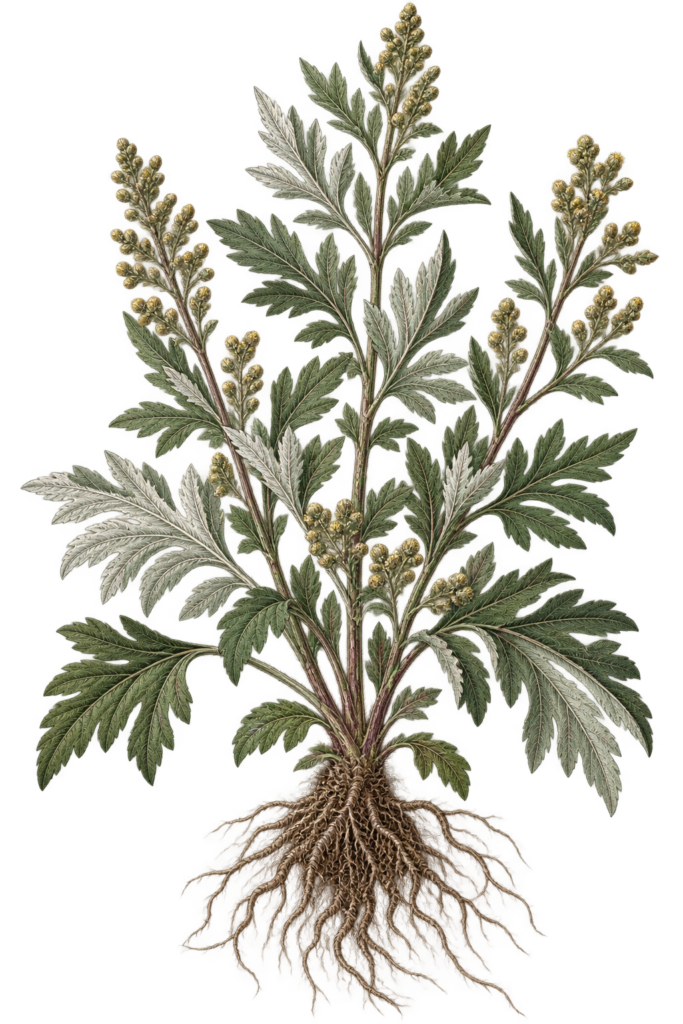
Mugwort belongs to the genus Artemisia within the aster/daisy family (Asteraceae). The genus comprises hundreds of aromatic, bitter herbs and shrubs, named after Artemis, the Greek goddess of the wilderness, childbirth, and the moon.
- Morphology & Foliage: Common mugwort (Artemisia vulgaris) is a hardy, rhizomatous perennial reaching 1 to 2.5 meters in height. It features grooved, often purplish stems and deeply dissected, pinnatifid leaves. A defining botanical field identifier is the striking contrast between the dark green upper leaf surface and the dense, silvery-white tomentose (woolly) hairs coating the underside.
- Inflorescence & Chemistry: Mugwort produces small, nondescript reddish-brown or yellowish composite flower heads arranged in long, branching panicles from midsummer to early autumn. The plant’s pungent, sage-like aroma is driven by volatile essential oils rich in cineole (eucalyptol), thujone, camphor, and sesquiterpene lactones.
| Species | Common Name | Native Region | Primary Distinction & Use |
| Artemisia vulgaris | Common Mugwort | Europe, Asia, North Africa | Classical European bitter, brewing herb, and dreamwork botanical |
| Artemisia argyi | Chinese Mugwort (Àicǎo) | East Asia | Primary species used in Traditional Chinese Medicine (TCM) for moxibustion |
| Artemisia princeps | Japanese Mugwort (Yomogi) | Japan, Korea | Culinary staple used in rice cakes (kusa mochi), tea, and baths |
| Artemisia absinthium | Wormwood | Eurasia, North Africa | Higher thujone concentration; primary bittering botanical in traditional absinthe |
| Artemisia ludoviciana | Western Mugwort / White Sagebrush | North America | Sacred ceremonial smudge herb among Indigenous North American nations |
Ancient Origins & Antiquity
Mugwort has been revered across Eurasia as both a sovereign medicine and a foundational ritual herb since prehistoric times.
- Classical Antiquity: Dioscorides (De Materia Medica) and Pliny the Elder documented mugwort as a potent emmenagogue and an essential herb for travellers, noting that carrying sprigs of Artemisia prevented weariness and protected the bearer from sunstroke, noxious beasts, and venomous bites.
- Ancient China & the Mawangdui Silk Texts: In ancient China, mugwort (Ài, 艾) was revered as an herb capable of dispelling cold, restoring yang energy, and repelling pathogenic qi. Medical texts discovered in the 2nd-century BCE Mawangdui Han tombs detail mugwort applications for channel therapy and thermal treatments.
- Anglo-Saxon Herbology: In the 10th-century Old English Lacnunga manuscript, mugwort is exalted in the Nine Herbs Charm (Nigon Wyrta Galdor) as Mucgwyrt, the “eldest of herbs” (yldost wyrta), possessing primary authority over poison, venom, and wandering airborne afflictions.
Folklore, Superstition & Cultural Traditions
Across medieval and early modern folklore, mugwort was considered a premier warding and visionary plant.
- Midsummer & St. John’s Eve: In European folk customs, garlands of mugwort were woven on Midsummer’s Eve and worn around the head or waist while dancing around bonfires. The wreaths were later cast into the flames or hung over stables and doorways to repel lightning, blight, witches, and malevolent spirits for the following year.
- The Traveller’s Charm: Roman soldiers and medieval pilgrims placed mugwort leaves inside their sandals or shoes before embarking on long journeys to stave off physical exhaustion, blister formation, and predatory animals.
- Dragon Boat Festival (Duanwu): In China, bundles of mugwort (A. argyi) and calamus (Acorus calamus) are hung on door frames during the fifth day of the fifth lunar month. The spear-shaped leaves and pungent aromatic fumes are believed to drive away venomous pests, evil spirits, and pestilence during the onset of summer heat.
Therapeutic & Medicinal Applications
In traditional pharmacopeias and modern phytotherapy, mugwort is classified primarily as an aromatic bitter, carminative, and emmenagogue.
- Moxibustion Therapy: In East Asian medicine, aged and processed mugwort leaves (moxa or moxawheat) are compressed into cones or sticks and burned directly or indirectly above specific acupuncture points. The radiant infrared heat and volatile terpenes stimulate micro circulation, dispel damp-cold stagnation, and tonify qi.
- Digestive Stimulation: As a bitter digestive tonic, mugwort stimulates the secretion of saliva, gastric acid, and bile. It is traditionally taken as an infusion to alleviate dyspepsia, flatulence, loss of appetite, and sluggish gastrointestinal motility.
- Emmenagogue Action: Mugwort gently stimulates pelvic and uterine circulation, historically prescribed to normalise delayed or scanty menstruation (amenorrhea) and ease spasmodic menstrual cramps.
- Safety & Contraindications: Strictly contraindicated during pregnancy due to its uterine-stimulating properties and risk of inducing contractions. Individuals allergic to plants in the Asteraceae family (e.g., ragweed) may experience contact dermatitis or respiratory allergy. Excessive internal consumption of concentrated preparations should be avoided due to the neurotoxic potential of thujone in high doses.
Astrological and Mystical Correspondences
| Category | Correspondence | Context & Significance |
| Planetary Ruler | Moon / Venus | Governed primarily by the Moon (ruling the subconscious, dreams, bodily fluids, and feminine cycles); secondary Venusian links to fertility and gentle easing of the womb. |
| Element | Earth / Water | Connected to Earth for physical grounding, protection, and endurance, and Water for intuition, trance, and psychic flow. |
| Zodiac Sign | Cancer / Pisces | Aligns with Cancer (lunar rhythm, maternal protection) and Pisces (liminal vision, dreaming, veil-thinning). |
| Gender/Polarity | Feminine / Yin | Receptive, intuitive, nocturnal, and restoring. |
| Tarot Correlation | The High Priestess / The Moon | Linked to esoteric wisdom, intuitive threshold-crossing, the subconscious, and illusion-piercing clarity. |
Culinary & Domestic Uses
- Aromatic Bittering & Brewing: Before hops became the universal standard in European brewing during the late Middle Ages, mugwort was a primary bittering agent in gruit ales (hence the common name derived from “mug-wort” or “drink-herb”).
- Rich Meats & Game: In traditional German and Northern European cooking, dried mugwort (Beifuß) is rubbed into fatty meats such as roast goose (Weihnachtsgans), pork belly, and duck to cut through rich lipids and ease post-meal digestion.
- East Asian Rice Cakes & Teas: In Japan, tender young yomogi shoots are blanched, ground, and folded into glutinous rice flour to create vibrant green, fragrant kusa mochi and dango. In Korea, ssuk is widely used in soups (ssukguk), herbal teas, and celebratory rice cakes (ssuktteok).
- Natural Insect Repellent: Bundles of dried mugwort hung in pantries or closets naturally deter moths, weevils, and flies due to its high cineole and camphor content.
Spiritual, Energetic & Metaphysical Properties
- Dream Incubation & Lucid Dreaming: Mugwort is the most widely utilised oneirogen (dream-inducing herb) in Western magical traditions. Placed under pillows, sewn into dream sachets, or sipped as a light bedtime infusion, it enhances dream recall, encourages vividness, and assists in lucid dream navigation.
- Scrying & Divination Support: An infusion of mugwort is traditionally used to wash scrying mirrors, crystal spheres, obsidian blades, and pendulum boards to cleanse energetic residue and tune the tool to psychic reception.
- Smudging & Purification: When burned on charcoal or as a tied bundle, mugwort smoke clears thick, stagnant astral residue without stripping the space of its natural sacred resonance.
Fun Facts
- Silver Reflectors in Moonlight: The silvery-white hairs on the underside of mugwort leaves reflect ambient moonlight, making the plant glow visibly along paths at night—one reason ancient travellers associated it with nocturnal safety.
- Beer Preservative: The antimicrobial volatile oils in mugwort not only flavoured medieval ales but also actively preserved them from turning sour before refrigeration and pasteurisation existed.
- John the Baptist’s Girdle: In medieval European lore, mugwort was colloquially called the “Girdle of St. John,” based on the legend that John the Baptist wore a crown and belt woven of mugwort for protection while living in the wilderness.
FAQ
How do I tell Common Mugwort apart from toxic lookalikes like Hemlock?
Turn the leaf over. Common Mugwort (Artemisia vulgaris) has a fuzzy, silver-white felt-like underside and a distinct sage-herbal scent when bruised. Highly toxic Poison Hemlock (Conium maculatum) has hairless green undersides, smooth hollow stems with distinct purple spotting, finely divided fern-like leaves, and an unpleasant, mousy odour.
Can I smoke or drink mugwort tea for lucid dreaming?
Yes, drinking a mild infusion (1 teaspoon dried herb steeped in boiling water for 5–10 minutes) roughly 30 to 45 minutes before sleep is a standard practice for dream work. Mugwort can also be smoked or blended with other herbs like mullein. However, start with very small amounts, do not use it continuously for long periods, and avoid it entirely if pregnant or breastfeeding.
Why is mugwort processed into moxa instead of using raw leaves?
Raw mugwort leaves contain coarse, green plant material and volatile moisture that burn too hot, unevenly, and with acrid smoke. Ageing and processing the leaves separates the soft, cottony trichome fibres (moxa wool), which burn slowly, evenly, and at a steady, penetrating therapeutic temperature.
