
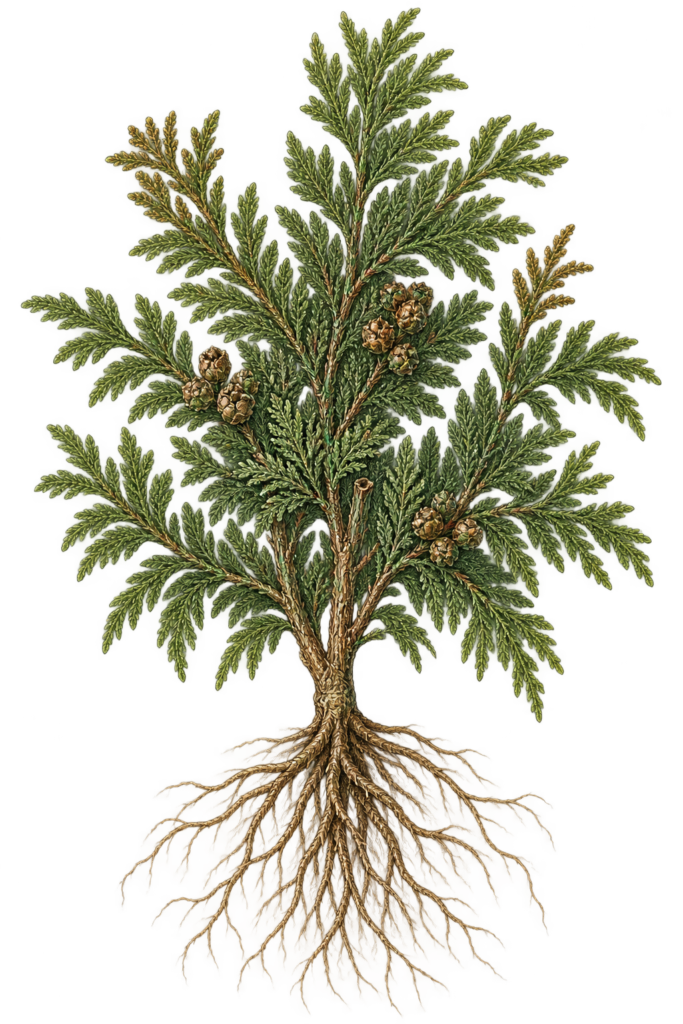
Few common plant names cause as much botanical confusion as cedar. Across history, forestry, and traditional medicine, the label has been applied liberally to fragrant evergreen conifers sharing resinous, rot-resistant wood and crisp, aromatic foliage. Scientifically, however, these trees belong to entirely different botanical families with distinct lineages, morphologies, and native range. The term cedar is commonly applied to two entirely distinct coniferous genera across two different plant families: true cedars (Cedrus) and arborvitaes or “false cedars” (Thuja).
| Feature | Cedrus (True Cedars) | Thuja (Arborvitae / False Cedars) |
| Family | Pinaceae (Pine family) | Cupressaceae (Cypress family) |
| Native Region | Mediterranean Basin, western Himalayas | North America, East Asia |
| Foliage | Clustered, evergreen, needle-like leaves | Flattened, fan-like, overlapping scales |
| Cones | Barrel-shaped, erect, disintegrating at maturity | Small, upright, persistent woody scales |
| Key Species | • Cedrus libani (Cedar of Lebanon) • Cedrus atlantica (Atlas Cedar) • Cedrus deodara (Deodar Cedar) | • Thuja plicata (Western Redcedar) • Thuja occidentalis (Northern Whitecedar) • Thuja standishii (Japanese Thuja) |
Ancient Origins & Antiquity
Both genera possess deep archaeological roots that shaped human Civilisation across opposite sides of the globe.
- Mesopotamia and the Levant (Cedrus): In the Epic of Gilgamesh (c. 2100 BCE), Gilgamesh ventures into the Cedar Forest guarded by the monstrous Humbaba to log the massive trees. Cedrus libani became the architectural backbone of antiquity: King Solomon traded with Hiram of Tyre for Lebanese cedar beams to build the First Temple in Jerusalem, while the Phoenicians built their maritime empire on cedar-planked galleys.
- Ancient Egypt (Cedrus): Because Egypt lacked large timber trees, Lebanese cedar was imported for royal sarcophagi, ritual boats (such as the Khufu ship buried beside the Great Pyramid), and resinous distillates (cedrium) used in mummification to deter decay and insects.
- Indigenous Pacific Northwest (Thuja): Known along the Pacific coast as the “Tree of Life” (Thuja plicata), Western red cedar sustained coast Salish, Haida, and Tlingit cultures for millennia. Archaeological wet sites show cedar bark cordage, baskets, and plank houses dating back over 3,000 years. Woodworkers harvested living planks without felling the parent tree, allowing the forest to endure.
Folklore, Superstition & Cultural Traditions
Because of their immense longevity, aromatic resins, and decay-resistant wood, both Cedrus and Thuja accrued rich folklore:
- Sanskrit Devadaru (Cedrus deodara): Translating directly to “timber of the gods,” ancient Himalayan sages (rishis) lived and meditated under sacred Deodar groves dedicated to Lord Shiva. Damaging a living grove invited divine misfortune.
- The “Tree of Life” Moniker (Thuja): When French explorer Jacques Cartier’s crew fell ill with scurvy in 1535, local Iroquoian peoples saved them using a tea brewed from Thuja occidentalis needles and bark. Cartier subsequently brought samples back to King Francis I, naming it l’Arbre de Vie (Arborvitae).
- Totemic Power and Protection: Pacific Northwest cultures carved monumental totem poles from single Thuja plicata trunks to record lineage, historical events, and supernatural guardians. Strips of inner bark were woven into waterproof clothing, regalia, and protective rings worn by dancers during winter ceremonials.
Therapeutic & Medicinal Applications
Both cedar trees produce high concentrations of bioactive secondary metabolites, notably terpenes, thujone, and tropolones.
These compounds confer their antimicrobial properties.
- Antimicrobial & Antifungal Properties: Heartwood of Thuja plicata contains thujaplicins (natural tropolones), which prevent fungal enzymatic decay. Thuja occidentalis tinctures have long been used topically in traditional herbalism to treat verrucae (warts) and fungal skin complaints.
- Respiratory Inhalations: Essential oils distilled from Cedrus atlantica wood (rich in himachalenes and atlantones) and steam infusions of Thuja foliage are traditional expectorants used to break up respiratory congestion and soothe bronchial spasms.
- Safety & Toxicity Caution: Thuja contains significant amounts of alpha- and beta-thujone, a neurotoxic monoterpene that can cause seizures and renal toxicity if ingested in concentrated forms or large quantities. Thuja essential oil should never be taken internally.
Culinary & Domestic Uses
- Cedar-Plank Grilling: Western red cedar (Thuja plicata) planks are widely used to slow-roast salmon and other proteins. As the damp wood heats over charcoal, it releases moisture and aromatic volatile oils that gently steam and smoke the food.
- Natural Insect Repellent: Both Cedrus heartwood blocks and Thuja shavings release volatile terpenoids that naturally disrupt the olfactory systems of clothes moths (Tineola bisselliella), carpet beetles, and silverfish, making cedar chests the historic standard for wool and linen storage.
- Specialised Craft & Timber:
- Thuja plicata is lightweight, straight-grained, and acoustically resonant, making it a premier soundboard tonewood for classical and acoustic guitars.
- Cedrus produces durable, rot-resistant timber historically favoured for exterior construction, roof shingles, fence posts, and shipbuilding.
Spiritual, Energetic & Metaphysical Properties
Across global ceremonial traditions, cedar is associated with grounding, purification, and spiritual elevation:
- Sacred Smudging & Incense: Along with sweetgrass, sage, and tobacco, Thuja is one of the Four Sacred Medicines of indigenous North American cosmology. Burning dried cedar fronds dispels stagnant or negative energy and invites benevolent influences before ceremonies.
- Sanctifying Ritual Spaces: In Western esoteric, Celtic, and Middle Eastern magical traditions, Cedrus incense is burned during solar rituals to invoke resilience, strength, authority, and emotional stability.
- Symbolism of Immortality: Because both species resist rot for centuries and maintain vibrant green foliage throughout harsh winters, cedar remains a universal emblem of endurance, incorruptibility, and eternal life.
fun facts
- The “Pencil Cedar” is neither Cedrus nor Thuja: The classic scent of wooden school pencil shavings comes from California Incense-cedar (Calocedrus decurrens) or Eastern Redcedar (Juniperus virginiana). Pencil manufacturers chose them because their straight grain sharpens smoothly without splintering along the graphite core.
- Most “Cedars” aren’t true cedars: Almost every tree called cedar in North America—including Western redcedar (Thuja), Atlantic white cedar (Chamaecyparis), and Eastern redcedar (Juniperus)—is actually in the cypress family (Cupressaceae). True cedars (Cedrus) are native only to the Mediterranean and Himalayas.
- Giant nurse logs: Fallen Thuja plicata trunks can take centuries to decay. In temperate rainforests, these fallen giants become “nurse logs” for hemlock and spruce seedlings. As the young trees mature, their roots wrap around the cedar trunk; once the log finally rots away hundreds of years later, the mature trees are left standing on tall “stilt” roots.
- The flagship flag: The Cedar of Lebanon (Cedrus libani) is featured centrally on Lebanon’s national flag and coat of arms. It is mentioned roughly 75 times in the Hebrew Bible as a symbol of strength, prosperity, and nobility.
- Culturally modified trees (CMTs): Indigenous peoples along the Pacific Northwest coast harvested planks and large sheets of bark from living Thuja plicata without killing the tree. Many of these living “donor” trees still thrive today, showing healed scar tissue from harvests that took place 300 to 500 years ago.
- Natural bug repellant evolution: The aromatic oils that give cedar closets their signature fragrance aren’t there for scent—they are chemical warfare. Cedar heartwood produces volatile aromatic compounds (thujone, cedrol, and thujaplicins) specifically to paralyze moth larvae and kill fungal spores attempting to feed on the wood.
Frequently Asked Questions
What is the difference between true cedar and false cedar?
- True Cedars (Cedrus): Belong to the pine family (Pinaceae) and are native to the Mediterranean Basin and Himalayas. They have stiff, clustered needle whorls and barrel-shaped upright cones.
- False Cedars (e.g., Thuja, Juniperus, Calocedrus): Belong to the cypress family (Cupressaceae) and are native across North America and East Asia. They feature flat, scale-like sprays of foliage rather than distinct needles.
What is the difference between true cedar and false cedar?
- True Cedars (Cedrus): Belong to the pine family (Pinaceae) and are native to the Mediterranean Basin and Himalayas. They have stiff, clustered needle whorls and barrel-shaped upright cones.
- False Cedars (e.g., Thuja, Juniperus, Calocedrus): Belong to the cypress family (Cupressaceae) and are native across North America and East Asia. They feature flat, scale-like sprays of foliage rather than distinct needles.
Why is cedar so resistant to rot and insects?
The heartwood of cedar wood produces natural organic compounds called thujaplicins, cedrol, and various terpenoids. These act as natural fungicides.
They inhibit fungal growth and disrupt the nervous systems of wood-boring insects and fabric moths.
Is cedar safe to burn as firewood or incense?
- Firewood: Cedar makes excellent kindling because its resinous oils ignite quickly and burn hot. However, it pops and sparks aggressively due to pocketed moisture and volatile oils, so it should only be used in enclosed wood burners or with a spark screen.
- Incense / Smudging: Dried foliage from Thuja and shaved wood from Cedrus have been burned ceremonially for millennia to cleanse spaces. Ensure proper ventilation, as the aromatic smoke is rich in natural resins.
Can cedar cause toxicity or skin reactions?
- Thujone toxicity: Foliage from Thuja contains thujone, which can be neurotoxic and cause kidney strain or seizures if concentrated essential oils or large amounts of tea are ingested.
- Contact dermatitis & respiratory irritation: Cedar sawdust and wood oils can trigger allergic skin reactions, contact dermatitis, or asthma-like symptoms (“western red cedar asthma”) in woodworkers handling unsealed timber without protective gear.
How do you maintain and restore cedar wood products?
- Cedar chests and closet blocks: Over time, the outer wood layer oxidises
- and seals in the aromatic oils. Lightly sanding the surface with fine-grit sandpaper (180–220 grit) reopens the wood pores and instantly restores the scent and insect-repellent properties.
- Outdoor decking and siding: Left untreated, cedar naturally weathers to a silvery-grey patina from UV exposure. Applying a penetrating semi-transparent oil or UV-inhibiting sealant every 2–3 years preserves its original warm red-brown tones.
Is cedar safe for pets and small animals?
Shavings from certain cedars release strong aromatic hydrocarbons (phenols). This affects small caged mammals such as hamsters, guinea pigs, and rabbits. Eastern Redcedar (Juniperus virginiana) and Western Redcedar (Thuja plicata) are particularly implicated. They can irritate the respiratory tracts and liver functions.
Kiln-dried aspen or paper bedding is recommended instead. Using these materials reduces exposure to the irritants found in cedar shavings. Choose them to provide a safer environment for small mammals. Ensure the bedding remains clean and dry. Regular changes help maintain air quality around small pets.
