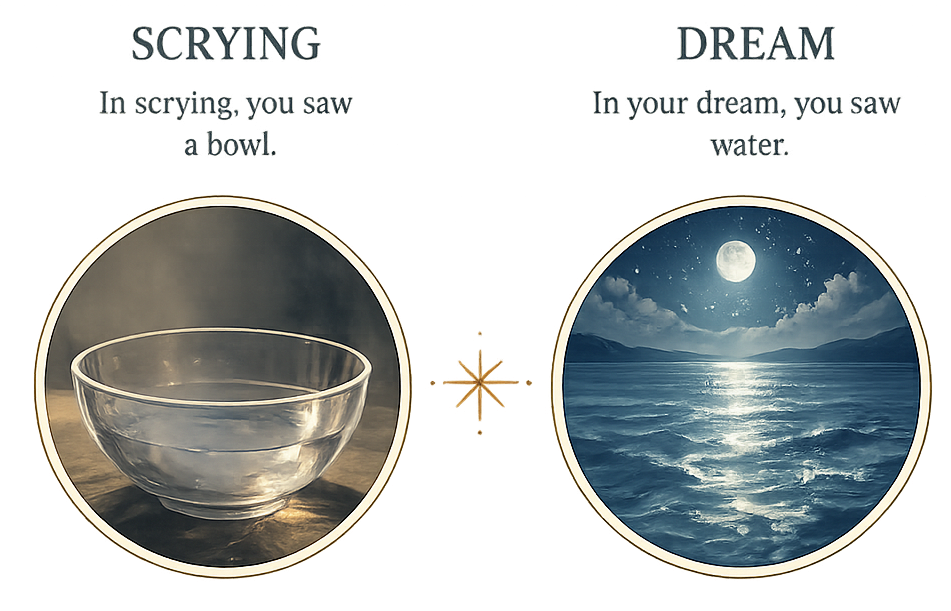
When you practice scrying and keep a dream journal simultaneously, you are engaging two intertwined intuitive practices. They share the same underlying psychological engine. Both scrying visions and night dreams use the language of subconscious symbolism to communicate thoughts, emotional processing, and intuitive hits. This may cross reference scrying symbols with waking experiences to deepen insight the analytical mind might filter out.
Cross-referencing your scrying logs with your dream records creates a powerful feedback loop. When a specific symbol, element, or feeling appears in both states, your subconscious is waving a giant red flag that says: “Pay attention—this matters.”
Here is a practical, step-by-step framework to map, compare, and decode repeating messages across your scrying sessions and dream cycles.
The Dual-State Symbol Matrix
The easiest way to track overlapping imagery is to set up a side-by-side comparison table in your master intuitive journal. Review your logs weekly and pull out recurring themes across both mediums:
| Core Theme / Symbol | Appearance in Scrying (Waking Trance) | Appearance in Dreams (REM State) | Subconscious Core Message |
| Water / Fluidity | Dark bowl of water showing turbulent, murky ripples | Dreaming of walking along a rising river or flooding house | Emotional overwhelm; a need to release unexpressed feelings. |
| Enclosed Spaces | Black mirror haze resolving into a tight geometric box | Dreaming of being trapped in a small elevator or narrow hallway | Feeling restricted in your current job or routine; seeking expansion. |
| Keys / Locks | Clear quartz sphere showing a faint brass key outline | Searching through pockets for a missing key in a dream | An answer or opportunity is already in your possession, but unacknowledged. |
Step-by-Step Mapping Protocol
1. Establish a Universal Keyword System
Weekly Review • 10 minutes
At the end of every week, scan both your scrying journal and dream logs for cross reference scrying symbols.
Additionally, highlight nouns (dog, door, storm, mirror) and emotional states (panic, stillness, longing) in two colours.
2. Identify Cross-State Matches
Pattern Spotting
Identify direct matches or thematic parallels between your waking trance state and your sleeping state, cross reference scrying symbols.
Additionally, do this within a rolling 14-day window.
- Direct Match: You see a serpent in a black mirror on Tuesday, and dream of a snake shedding its skin on Thursday.
- Thematic Parallels: You see a falling leaf during candle scrying, and dream of driving down an autumn road surrounded by bare trees.
3. Differentiate ‘Echoes’ from ‘Core Messages’
Not every overlap is a deep message. Differentiate between:
- Sensory Echoes: Seeing a candle flame in a dream after candle scrying is just your brain processing the physical environment of your session.
- Subconscious Core Messages: A symbol that appears with emotional resonance in both states—especially when the context changes—indicates a persistent subconscious priority.
4. Synthesise the State Differences
Notice how the symbol behaves differently in waking vs. sleeping states:
- Scrying (Controlled/Passive): How do you observe the symbol when you are awake and safe? (e.g., Looking at a storm in a water bowl with calm curiosity).
- Dreaming (Active/Unfiltered): How do you react when your ego mind is completely asleep? (e.g., Running away from the storm in fear).
- The Insight: The difference between the two reveals where your waking mind is in denial or where your nervous system still holds tension.
3. Key Questions to Unlock Cross-State Symbols
When you identify a symbol present in both your scrying logs and dream journals, ask yourself.
These are three core integration questions, including how to cross reference scrying symbols.
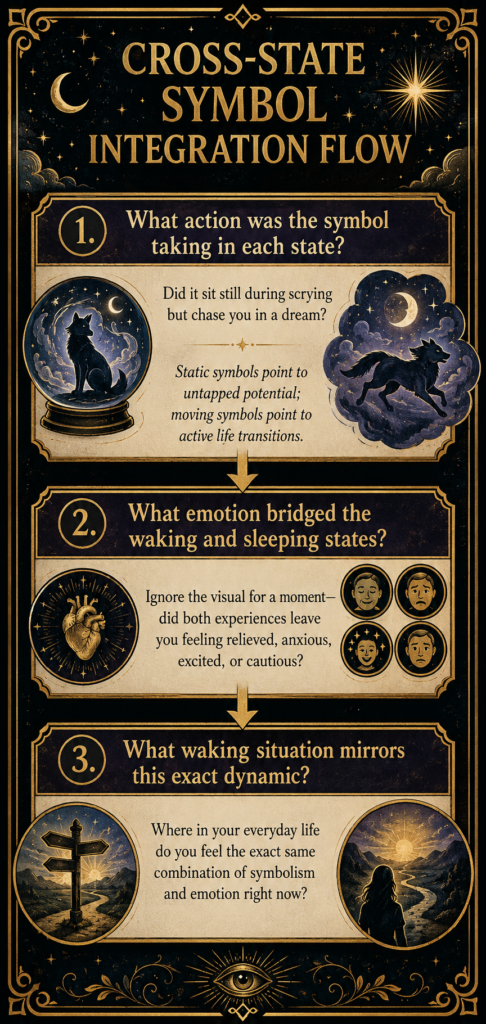
The Integration Principle: When a scrying symbol and a dream image align, stop researching external symbol dictionaries. Your subconscious has built its own unique lexicon. Record what you were experiencing in your life during the days that specific overlap occurred—that real-world context is the true key to unlocking the message.
Frequently Asked questions
How do scrying and dream journaling complement each other and share the same underlying psychological engine?
When you practice scrying and keep a dream journal simultaneously, you are engaging two intertwined intuitive practices that use the same underlying psychological engine. Both forms of imagery communicate thoughts, emotional processing, and intuitive hits through subconscious symbolism, and cross-referencing them can deepen insight that the analytical mind might otherwise filter out.
What is the Dual-State Symbol Matrix and how should I use it to track symbols across waking and dreaming states?
The Dual-State Symbol Matrix is an easy side-by-side method to track overlapping imagery. Create a master intuitive journal with columns for Core Theme or Symbol, Appearance in Scrying (Waking Trance), Appearance in Dreams (REM State), and Subconscious Core Message. Review the matrix weekly and pull out recurring themes across both states to identify messages your subconscious is signalling.
How do I perform the Step-by-Step Mapping Protocol, especially establishing a universal keyword system and identifying cross-state matches?
Follow the protocol: first, establish a universal keyword system by spending about 10 minutes weekly to scan both scrying journals and dream logs, highlighting nouns and emotional states in two colours. Next, identify cross-state matches within a rolling 14-day window, noting direct matches and thematic parallels like a serpent in scrying and a dream of shedding skin. Finally, synthesise these findings to see how symbols recur across states.
How can I differentiate echoes from core messages when symbols overlap in both waking and dreaming states?
Differentiate by separating sensory echoes from subconscious core messages. Sensory echoes are instrumental like a candle flame in a dream following candle scrying and reflect how your brain processed the session’s environment. Core messages are symbols that appear with emotional resonance in both states, especially when the context shifts, indicating persistent subconscious priorities.
What is the Integration Principle for cross-state symbols and how should real-world context influence interpretation?
The Integration Principle states that when a scrying symbol aligns with a dream image, you should stop relying on external symbol dictionaries. Your subconscious has its own lexicon. Record the real-world context of your life during the overlaps—this lived context is the true key to unlocking the message.