Garnet Beliefs: Ancient narratives and talismans
Long before modern gemmology, garnets were grouped by silicates and crystal habits. Ancient civilisations revered red garnets as living embers of Earth’s primary fire. Carbuncle was a common ancient name for red garnet, valued as more than decoration. They were believed to radiate light even in absolute darkness. Some legends linked them to healing haemorrhages and shielding warriors from wounds. Across cultures, red garnet symbolised vitality and protection. These beliefs persisted through time, shaping personal talismans and ceremonial objects. From the stormy waters of the Biblical Flood to Sutton Hoo burials, garnet features in rich narratives. Its story ranks among the most substantial of any mineral on Earth. Histories of trade also spread these tales further.
This guide considers Garnet Beliefs shaped artefacts and sites. It surveys cultural legends, archaeological masterpieces, and protective talismans. Together they reveal how garnet shaped historical memory and daily life. Readers gain insight into the enduring symbolism attached to red gems.
The Etymology of Carbuncle: The Glowing Fire Coal
To trace Garnet Beliefs through ancient literature, one must first understand the term carbuncle. Derived from the Latin carbuncles—meaning “little coal” or “glowing charcoal”—the word described polished red cabochon gemstones that seemed to ignite with internal fire when held against sunlight.
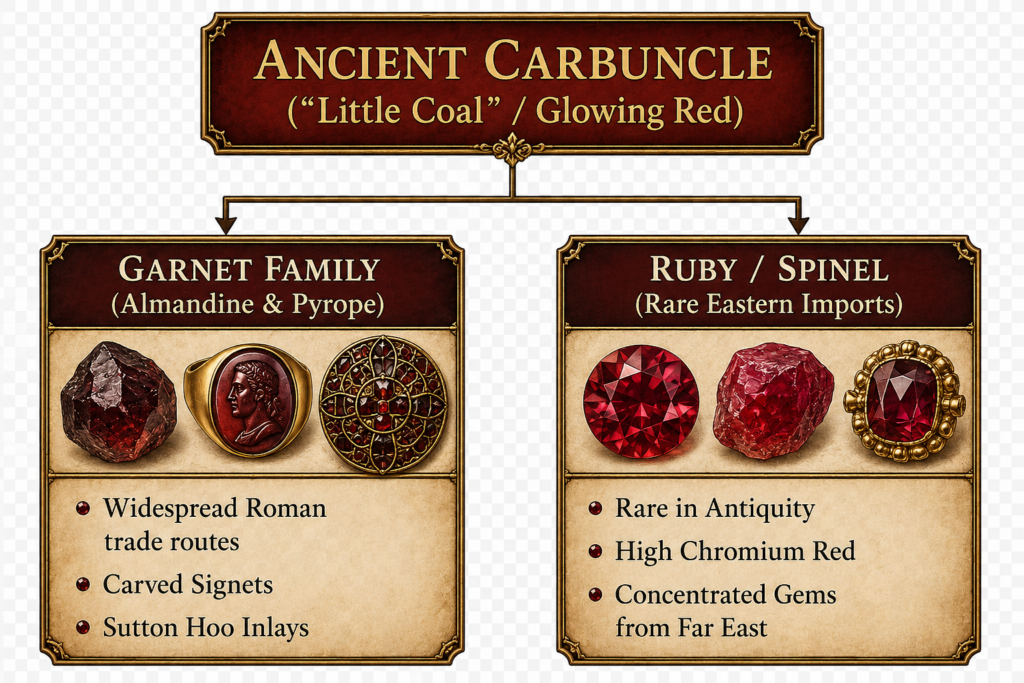
In ancient and medieval times, lapidaries did not differentiate minerals using chemical composition. Consequently, the term carbuncle served as a broad umbrella title for deep red gems. It included Almandine and Pyrope garnets, spinels, and rubies.
However, garnet was far more accessible across Mediterranean trade routes than ruby. This accessibility meant that the vast majority of historical carbuncles examined by modern archaeologists have proven to be cut garnets. Such garnets were widely traded and valued in medieval and ancient networks.
The Roman natural philosopher Pliny the Elder (23–79 AD) dedicated extensive passages in his Naturalis Historia to carbuncles, noting their commercial dominance across imperial trade networks. Roman officials favoured carved garnet intaglios for official signet rings. Because hot sealing wax did not stick to the smooth surface of polished garnet, Roman leaders used carved garnet rings to stamp their personal emblems onto imperial documents and wax-sealed letters.
Luminous Legends: Noah’s Ark and Sacred Hebrew Lore
One of the most enduring mystical legends surrounding garnet involves the story of Noah and the Great Flood. According to Talmudic traditions and ancient Rabbinic lore, the sun and moon were shrouded in storm clouds for forty days and forty nights. To navigate the Ark through pitch darkness, Noah suspended a giant, finely cut, glowing carbuncle—traditionally identified as a red garnet—from the central beam of the vessel.
This single gemstone was said to illuminate the entire interior hall, radiating an supernatural internal glow that guided the Ark safely across the dark waters.
Garnet also occupies a sacred position in Hebrew scriptural history through the Hoshen, the ceremonial breastplate worn by the High Priest of Israel described in the Book of Exodus. Set with twelve gems representing the twelve tribes of Israel, the stone Bareqeth (or Nophek, depending on translations) is widely associated with red garnet or carbuncle.
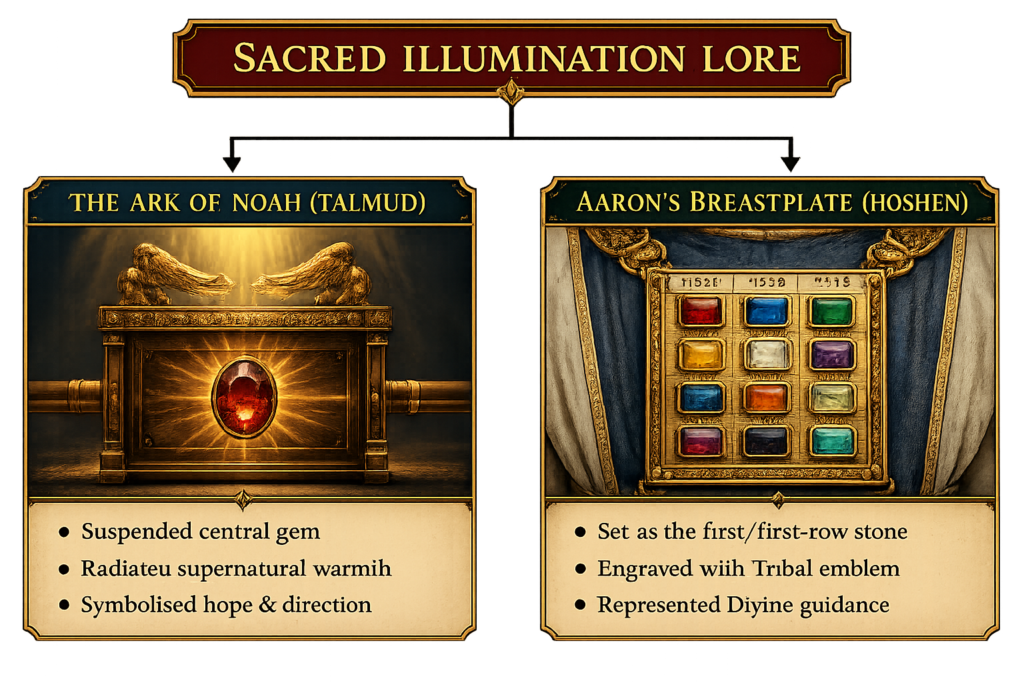
Tradition holds that carbuncle was also one of the four precious gems gifted by God to King Solomon, bestowing him with authority over earthly creatures and spiritual realms.
Dark Age Masterpieces: Anglo-Saxon Sutton Hoo Cloisonné
During the Migration Period and early Middle Ages (5th to 8th centuries AD), European goldsmiths elevated garnet cutting to unprecedented artistic heights through the art of cloisonné. Rather than faceting gems into individual prongs, master artisans soldered delicate gold wires to base metal plates, creating tiny cells (cloisons) filled with thin, flat slices of red garnet.
The most magnificent archaeological proof of this craftsmanship emerged in 1939 during the excavation of the Sutton Hoo ship burial in Suffolk, England—the burial site of an Anglo-Saxon king, likely King Rædwald of East Anglia (died c. 624 AD).
Among the treasures recovered were royal shoulder clasps, a purse lid, and ceremonial sword hilts decorated with thousands of millimetre thin garnet tiles. To maximise the stone’s luminescence in dim, torchlight halls, Anglo-Saxon jewellers devised an ingenious optical technique:
- They sliced garnet rough into wafer-thin leaves measuring less than a millimetre in thickness.
- Underneath each transparent garnet tile, they inserted a piece of stamped waffle-patterned gold foil.
- When light struck the garnet, it passed through the red gem, bounced off the patterned gold grid underneath, and reflected outward, creating a shimmering geometric brilliance.
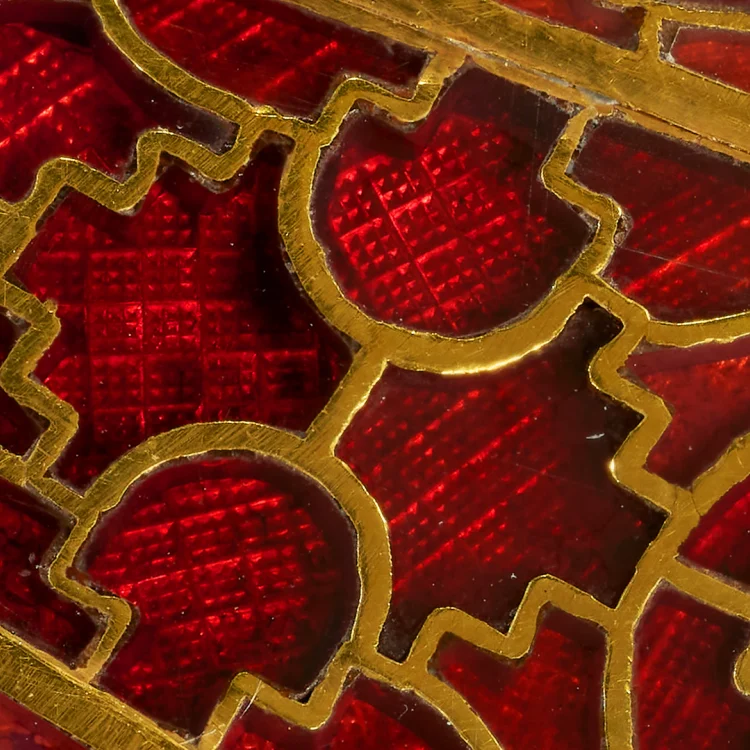
To early Anglo-Saxon warriors, these blood-red garnet fittings were not merely symbols of kingly wealth; they served as protective amulets embedded directly into war gear to grant courage, repel death, and display divine royal favour.
Knights and Shields: Crusader Talismans and Blood Magic
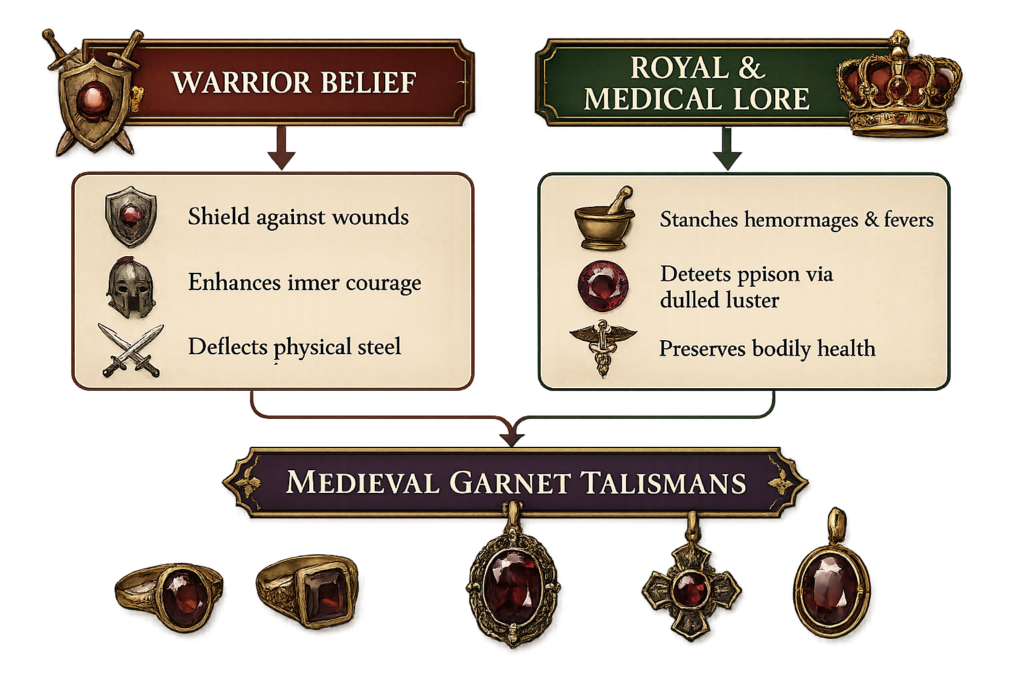
As Europe entered the High Middle Ages, garnet’s reputation shifted heavily toward battlefield protection and warrior talismans. Medieval knights and Crusaders routinely set garnets into their armour, shields, and sword pommels before departing for campaigns in the Holy Land.
The Magic of Blood Sympathy
Due to the principle of “sympathetic magic,” medieval healers and soldiers believed a stone’s physical appearance mirrored its magical effects. Because garnet mirrored the dark red hue of arterial blood, it was believed to possess direct power over physical blood:
- Staunching Wounds: Doctors pressed polished garnets against open injuries to stop haemorrhages and prevent inflammation.
- Repelling Wounds: Knights believed wearing garnet armour fittings would cause opposing spear tips and sword blades to slide harmlessly away from their bodies.
- Curing Toxins: Grimoires claimed that garnet protected against poisons. If placed in a goblet containing poison, the gem’s natural lustre was said to instantly dull to warn the drinker of approaching danger.
The Engraved Lion Symbolism
Medieval lapidary texts frequently instructed warriors to carve the figure of a lion onto a red garnet cabochon. A garnet engraved with a lion was believed to form a master protection talisman capable of preserving physical health, curing fever, granting military honours, and ensuring the safety of travellers crossing dangerous foreign territories.
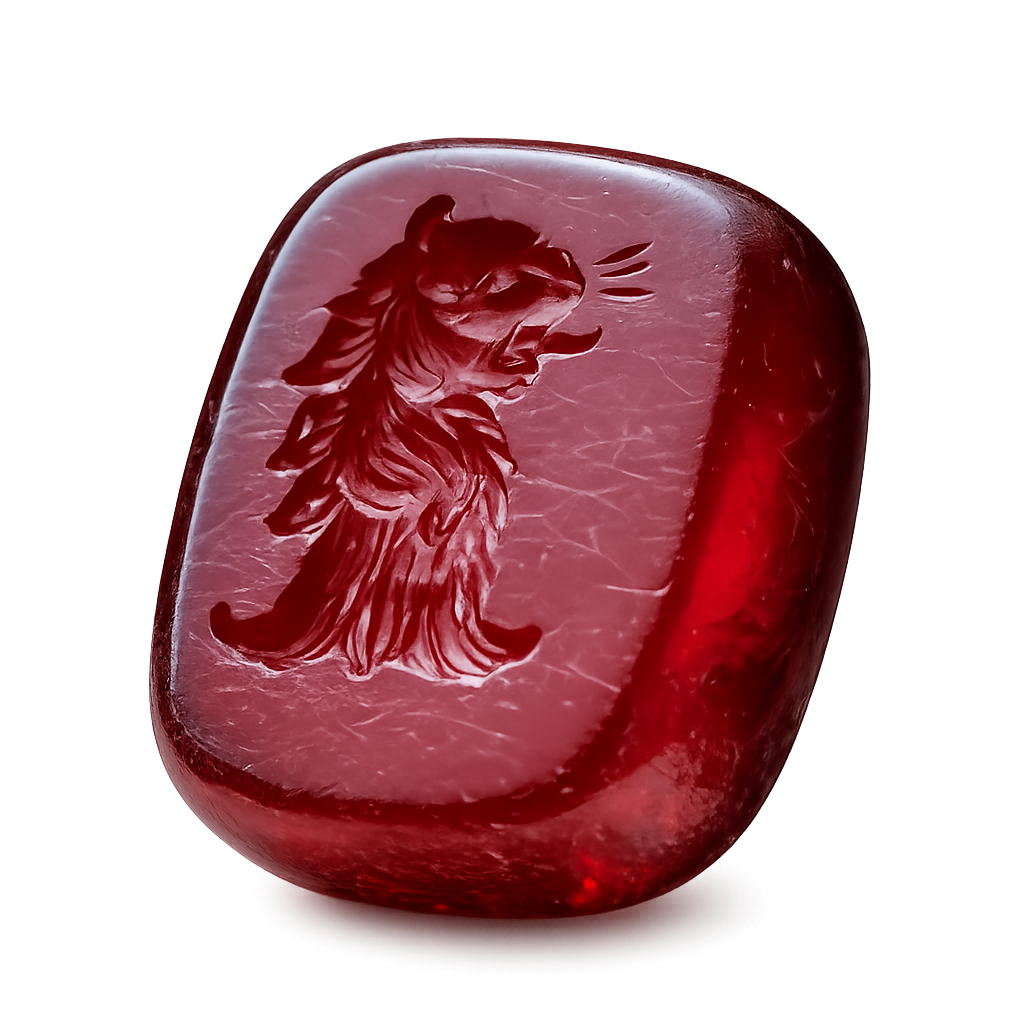
This tradition of using garnets in battle persisted into late history. In the late 19th century along the Kashmir border, native tribes reportedly used rounded garnet pellets as ammunition against British troops, believing the heavy blood-red stones inflicted far deadlier wounds than standard lead bullets.
Frequently Asked Questions (FAQ)
Why were red garnets called “carbuncles” in ancient texts?
The word carbuncle comes from the Latin carbuncles, meaning “little burning coal.” Ancient peoples used this term to describe all glowing red cabochon gems, including garnets, rubies, and spinels. This because they lacked chemical testing equipment to differentiate mineral species.
Is the glowing gem on Noah’s Ark historically verified as a garnet?
While the legend stems from Talmudic and Rabbinic tradition rather than direct historical records, scholar and lapidary folklore heavily link the illuminating gem of the Ark to a large, polished red carbuncle (garnet), celebrated for its intense internal light dispersion under torchlight.
How did Anglo-Saxon jewellers make Sutton Hoo garnets look so bright?
Anglo-Saxon goldsmiths backed paper-thin garnet slices with waffle-patterned gold foil inside tiny gold cells (cloisonné). Light passing through the red stone reflected off the textured gold backing, creating an intense, glittering geometric pattern.
Why did medieval Crusader knights wear garnet into battle?
Medieval soldiers believed in the law of sympathetic magic. Because garnet matched the deep red colour of human blood, knights believed the stone could stanch bleeding wounds, repel enemy weapons, grant physical courage, and protect against poison.
Why did medieval Crusader knights wear garnet into battle?
Medieval soldiers believed in the law of sympathetic magic. Because garnet matched the deep red colour of human blood, knights believed the stone could stanch bleeding wounds, repel enemy weapons, grant physical courage, and protect against poison.
What does the historical legend of Persephone have to do with garnet?
n Greek mythology, Hades gave Persephone pomegranate seeds before she left the underworld to ensure her safe return. Because garnet crystals naturally resemble deep-red pomegranate seeds (granatus), historical tradition established garnet as the ultimate gift exchanged between departing travellers to guarantee a safe reunion.
To learn more about the complete mineral group—including chemical composition, modern chakra alignments, and crystal pairings—explore our foundational Garnet Stone: Science, Lore & Metaphysical Healing Guide