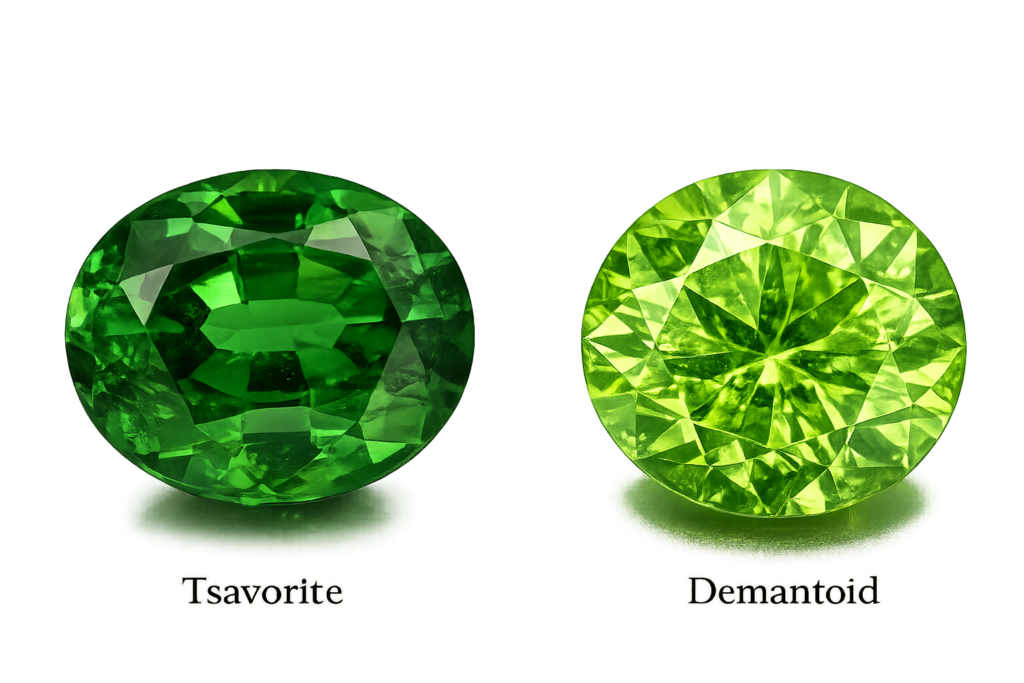
While red garnets have graced royal crowns and protective amulets for thousands of years, the mineralogical world harbours a far rarer and more captivating subset of this gemstone group: green garnets. Chief among these are Tsavorite and Demantoid, two distinct varieties that consistently outshimmer traditional emeralds in fire, clarity, and structural durability.
Despite both exhibiting striking emerald-to-forest green profiles, Tsavorite and Demantoid belong to entirely different chemical species within the garnet group. Understanding their elemental signatures, optical behaviors, inclusions, and geological formations reveals why these two gems represent the pinnacle of fine gemstone collecting.
Chemical Species: Grossular vs. Andradite
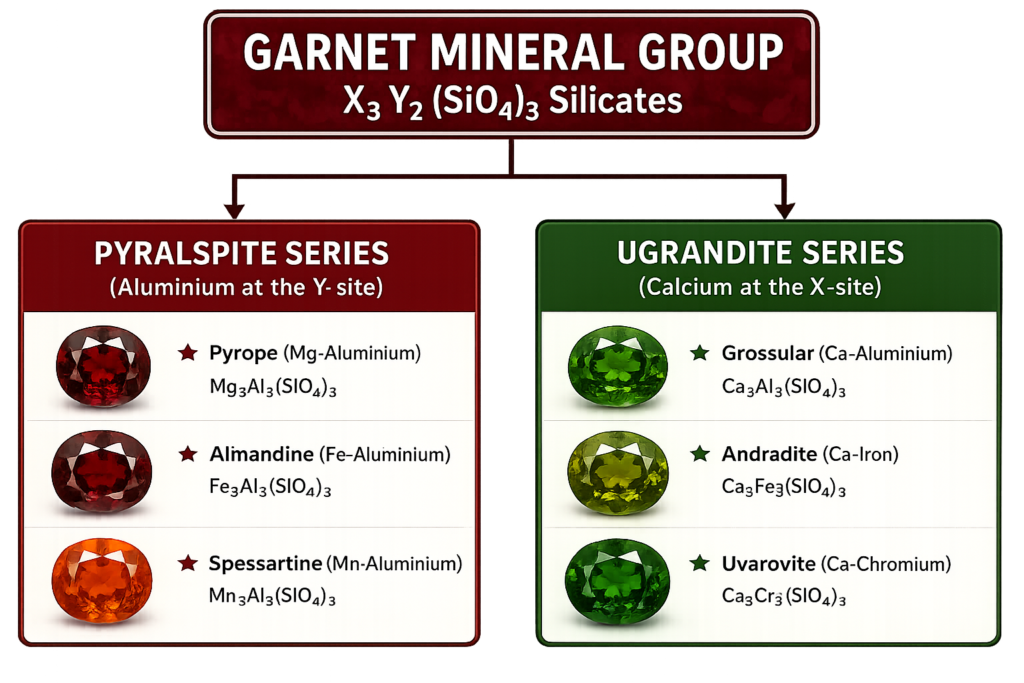
To understand the differences between Tsavorite and Demantoid, one must examine the solid-solution series of the garnet group. Garnets share an isometric crystal structure with the general formula $X_3Y_2(SiO_4)_3$, but their physical and optical characteristics diverge based on which metal cations occupy the X (divalent) and Y (trivalent) crystallographic sites.
Tsavorite: The Vanadium-Rich Grossular
Tsavorite is the gem-quality, vivid green variety of Grossular garnet. Its ideal chemical formula is:
$$\text{Ca}_3\text{Al}_2(\text{SiO}_4)_3$$
In pure grossular garnets, calcium occupies the dodecahedral X-site and aluminium occupies the octahedral Y-site. Pure calcium-aluminium silicate is completely colorless; Tsavorite acquires its famous forest-to-emerald hue through trace element substitution within its crystal matrix.
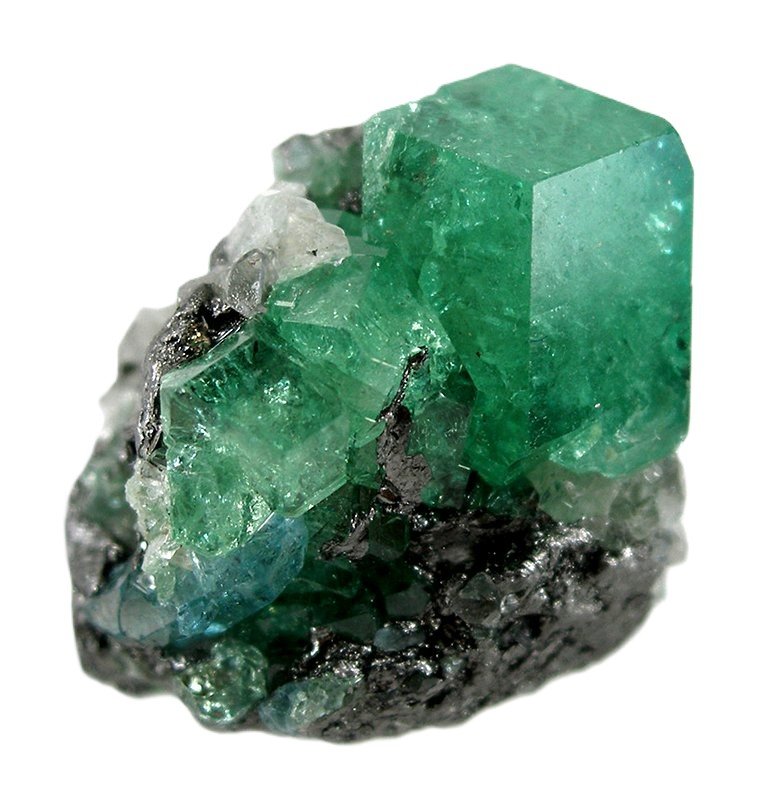
Tsavorite is the gem-quality, vivid green variety of Grossular garnet. Its ideal chemical formula is:
$$\text{Ca}_3\text{Al}_2(\text{SiO}_4)_3$$
In pure grossular garnets, calcium occupies the dodecahedral X-site and aluminium occupies the octahedral Y-site. Pure calcium-aluminium silicate is completely colourless; Tsavorite acquires its famous forest-to-emerald hue through trace element substitution within its crystal matrix.
Demantoid: The Iron-Rich Andradite
Demantoid is the ultra-rare green variety of Andradite garnet. Its chemical formula is:
$$\text{Ca}_3\text{Fe}_2^{3+}(\text{SiO}_4)_3$$
While both species share calcium in the X-site, Andradite replaces the aluminium in the Y-site with trivalent ferric iron ($\text{Fe}^{3+}$). This heavy concentration of iron fundamentally changes the mineral’s optical properties, resulting in extreme light dispersion and higher density.
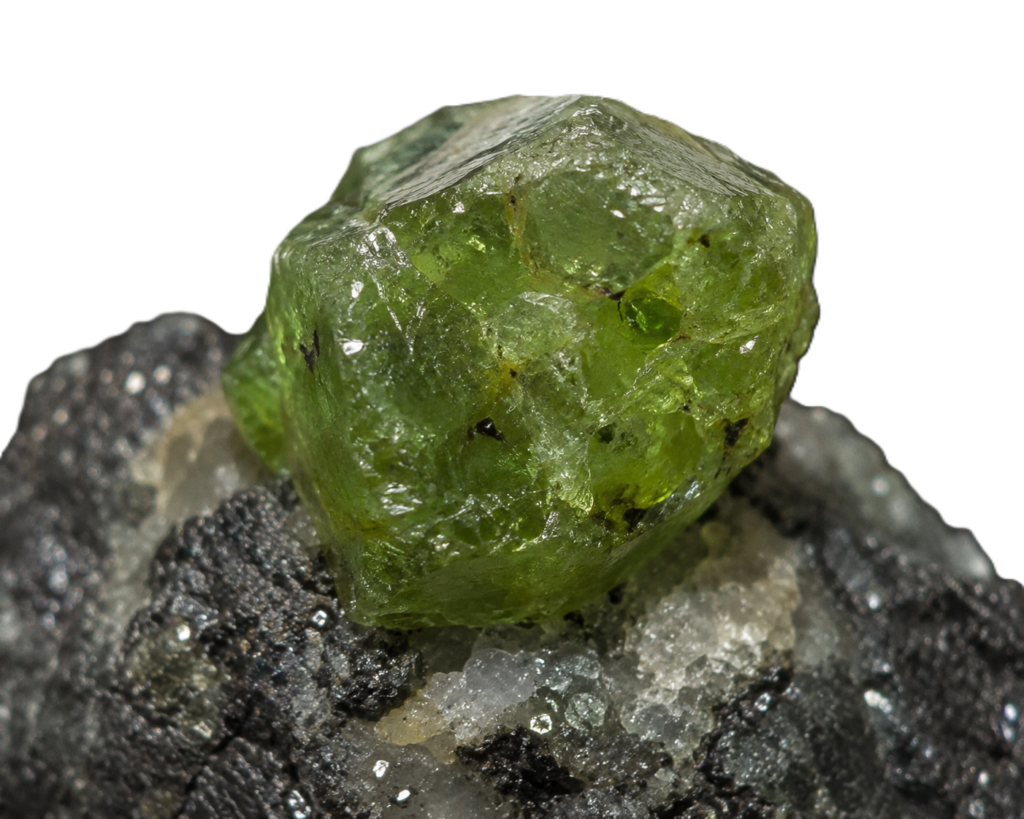
Demantoid is the ultra-rare green variety of Andradite garnet. Its chemical formula is:
$$\text{Ca}_3\text{Fe}_2^{3+}(\text{SiO}_4)_3$$
While both species share calcium in the X-site, Andradite replaces the aluminium in the Y-site with trivalent ferric iron ($\text{Fe}^{3+}$). This heavy concentration of iron fundamentally changes the mineral’s optical properties, resulting in extreme light dispersion and higher density.
Chromophores: Vanadium vs. Chromium Colour Causes
The vivid green coloration in both gems stems from transition metal ions absorbing specific wavelengths of light within the visible spectrum. However, the dominant chromophores (color-causing agents) differ significantly between the two.
| Optical & Chemical Feature | Tsavorite (Grossular) | Demantoid (Andradite) |
| Primary Species | Grossular ($\text{Ca}_3\text{Al}_2(\text{SiO}_4)_3$) | Andradite ($\text{Ca}_3\text{Fe}_2(\text{SiO}_4)_3$) |
| Primary Chromophore | Vanadium ($\text{V}^{3+}$) with trace Chromium ($\text{Cr}^{3+}$) | Chromium ($\text{Cr}^{3+}$) with background $\text{Fe}^{3+}$ |
| Refractive Index (RI) | 1.740 | 1.880 – 1.890 |
| Dispersion (Fire) | 0.028 | 0.057 (Exceeds Diamond at 0.044) |
| Mohs Hardness | 7.0 – 7.5 | 6.5 – 7.0 |
| Specific Gravity | 3.60 – 3.68 | 3.82 – 3.85 |
| Diagnostic Inclusions | Apatite crystals, graphite, liquid veils | Horsetail Chrysotile Fibers |
The Colour Science of Tsavorite
Tsavorite owes its primary saturation to trivalent Vanadium ($\text{V}^{3+}$) replacing aluminium in the crystal lattice, supplemented by minor amounts of Chromium ($\text{Cr}^{3+}$). Vanadium absorbs light heavily in the violet-blue and yellow-red regions of the spectrum, transmitting a crisp, pure green hue. Because vanadium causes minimal internal fluorescence, Tsavorite exhibits a rich, saturated shade that remains colour-stable under diverse lighting conditions.
The Colour Science of Demantoid
Demantoid derives its vivid green strictly from Chromium ($\text{Cr}^{3+}$) substituting for ferric iron in the andradite structure. However, because the baseline andradite matrix is already saturated with trivalent iron ($\text{Fe}^{3+}$), low concentrations of chromium yield yellow-green or olive tones. Only when chromium levels rise significantly does the stone achieve the intense emerald-green shade prized by gemologists.
Optical Phenomena: Dispersion and Radiance
One of the most striking differences under a gemological microscope is how these two garnets process light.
Demantoid’s Diamond-Like Fire
The name Demantoid originates from the old German word Demant, meaning “diamond-like.” This moniker is scientifically earned: Demantoid possesses an extraordinary optical dispersion rating of 0.057.
Dispersion measures a gemstone’s ability to split white light into its spectral component colours (fire). To put this in perspective:
- Diamond Dispersion: 0.044
- Tsavorite Dispersion: 0.028
- Demantoid Dispersion: 0.057
When light enters a well-cut Demantoid, the high dispersion splits incoming rays into rainbow flashes of red, orange, and blue that erupt through the green body color, an optical phenomenon unmatched by almost any other precious gemstone.
Tsavorite’s High Clarity and Radiance
While Tsavorite has a lower dispersion (0.028) and refractive index (1.740) compared to Demantoid, it compensates with higher natural clarity and light transmission. Unlike emeralds, which are notoriously fractured and require oiling, Tsavorite forms with exceptionally clean crystal interiors. This high clarity, combined with a single refractive index, gives cut Tsavorites an intense, uninterrupted brilliance.
Inclusions: Identifying Demantoid’s Signature “Horsetail”
In gemology, inclusions are often viewed as structural flaws. However, in the case of Demantoid garnets, a specific inclusion pattern dramatically increases both gemological authenticity and market value: the horsetail inclusion.
What is a Horsetail Inclusion?
A horsetail inclusion consists of curving, golden-yellow fibrous threads of chrysotile (a serpentine mineral group) radiating outward from a central nucleating core, usually a small crystal of chromite or magnetite.
These delicate fibres fan out across the interior of the faceted gem, mimicking the sweeping hair of a horse’s tail.
Diagnostic Significance and Value
- Geological Origin Indicator: Horsetail inclusions occur almost exclusively in Demantoid garnets formed within serpentinised ultramafic metamorphic environments, most notably in Russia’s Ural Mountains. Demantoids mined from skarn deposits (such as those in Namibia or Madagascar) typically lack these chrysotile fibres.
- Value Retention: Unlike most gemstones where internal inclusions decrease market price, a well centred, spray-like horsetail inclusion in a Russian Demantoid actually increases its value, serving as internal proof of origin and natural creation.
In contrast, Tsavorite garnets display inclusions typical of high-grade metamorphic rocks, such as negative crystals, liquid-filled veils, rounded apatite crystals, and tiny black graphite flakes.
Geological Formation & Mining Locations
Both gemstones require delicate, highly unusual geological conditions to form, making large, gem-quality rough exceptionally scarce.
Tsavorite Deposits
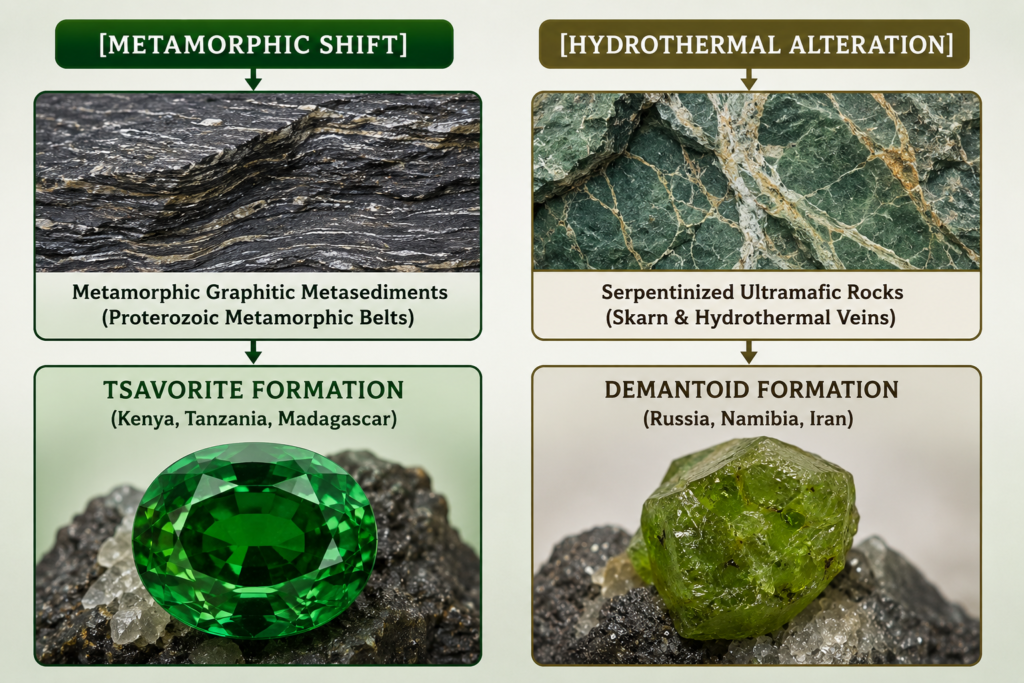
Discovered in 1967 by British gemologist Campbell Bridges in Tanzania and later mapped along Kenya’s Tsavo National Park belt, Tsavorite forms in ancient Proterozoic metamorphic rocks. It crystallises within graphitic meta sediments, calc-silicate rocks, and marble bands subjected to high-grade regional metamorphism ($600^\circ\text{C}$ to $750^\circ\text{C}$ under $4$ to $6\text{ kbar}$ pressure).
- Primary Sources: Kenya (Tsavo region), Tanzania (Merelani Hills), and Madagascar.
Demantoid Deposits
Demantoid was first discovered in 1853 in the Ural Mountains of Russia, where it quickly became a favourite of the Russian Imperial Court and master jeweller Carl Fabergé. Russian deposits formed via hydrothermal alteration of ultramafic serpentinites. Non-Russian deposits, such as those discovered later in Namibia and Iran, formed in contact metamorphic skarns.
- Primary Sources: Russia (Ural Mountains), Namibia (Green Dragon Mine), Madagascar, and Iran.
Market Value, Rarity, and Collector Demand
Due to their extreme geological scarcity, both Tsavorite and Demantoid command high per-carat prices in the global gemstone trade, frequently exceeding high-grade emeralds.
Rarity Scale and Sizes
- Tsavorite: While clean stones under 1 carat are accessible, gem-quality Tsavorites over 3 carats are rare. Fine specimens over 5 carats are considered museum-grade treasures.
- Demantoid: Demantoid is even rarer in large sizes. High-clarity Russian Demantoid gems over 1 carat are scarce, and stones exceeding 3 carats are among the rarest gems in existence.
Valuation Drivers
When evaluating these green garnets on the commercial market, collectors weigh different primary criteria:
- For Tsavorite: Color saturation is paramount. The ideal shade is a vibrant, deep emerald green with pure saturation (neither too yellowish nor overly dark/blackened). Clarity and carat weight exponentially increase per-carat prices.
- For Demantoid: While vivid chromium green remains the primary driver, optical fire and provenance play massive roles. A Russian Demantoid exhibiting lower colour saturation but possessing a prominent, artfully centred horsetail inclusion will often out-value a cleaner, darker stone from another geographic region.
Summary of Distinction
Both Tsavorite and Demantoid offer fine jewellery collectors something emeralds cannot: superior durability (lacking weak cleavage planes), higher natural brilliance, and a 100% natural presentation free from commercial clarity-enhancing resins or oils.
Whether drawn to the intense, vanadium-fueled forest green of a Kenyan Tsavorite or the diamond-surpassing dispersion and golden chrysotile sprays of a Russian Demantoid, these two species stand as the undisputed titans of the green gemstone world.
For a broader overview of the entire garnet mineral group—including red Almandine, fiery Spessartine, and ancient gemstone lore—return to our comprehensive [Garnet Stone: Science, Lore & Metaphysical Healing Guide].
Frequently Asked Questions: Tsavorite vs. Demantoid
Which is more valuable: Tsavorite or Demantoid?
While both gems command top-tier per-carat prices that frequently eclipse fine emeralds, Demantoid is generally more expensive per carat, particularly for fine Russian specimens over 1 carat. This price premium is driven by Demantoid’s extreme geological scarcity and its higher light dispersion (fire). However, top-grade, intense emerald-green Tsavorites over 3 carats are also exceptionally rare and can match or exceed high-end Demantoid prices.
How can I visually tell the difference between Tsavorite and Demantoid?
- Light & Fire: Look at the gem under direct spotlighting. Demantoid has an extraordinary dispersion (0.057) that produces rainbow flashes of red, orange, and blue beneath its green body color. Tsavorite offers high, crisp brilliance, but lacks these fiery multi-colored spectral flashes.
- Inclusions: Under a 10x gemological loupe, high-value Russian Demantoids often display golden, fanning “horsetail” chrysotile inclusions. Tsavorites typically feature clean interiors or graphite/apatite inclusions instead.
- Color Tone: Tsavorite trends toward a pure, rich forest or emerald green, while Demantoid frequently carries subtle olive or yellowish-green secondary undertones unless it contains heavy chromium saturation.
Are Tsavorite and Demantoid garnets treated or enhanced?
Unlike emeralds—which are routinely oil-treated, resin-filled, or fracture-sealed—Tsavorite and Demantoid are overwhelmingly 100% natural and untreated. They are cut directly from raw rough with no heat treatment, radiation, or clarity enhancements. This pure, untreated nature makes them highly favored by gem collectors who prioritize natural integrity.
Are green garnets durable enough for everyday engagement rings?
Yes, both green garnet species are significantly more durable than emeralds because they lack weak, internal cleavage planes.
- Tsavorite ranks 7.0 to 7.5 on the Mohs scale, making it sturdy and highly resistant to daily scratching.
- Demantoid is slightly softer at 6.5 to 7.0, meaning it requires a bit more care. For daily rings, Demantoid is best set in protective bezel settings to shield its facet edges from hard impacts.
Why are Tsavorite and Demantoid better alternatives to Emerald?
- Brilliance & Fire: Both garnets possess higher refractive indices than emerald (Beryl), making them significantly brighter. Demantoid also exhibits far superior fire/dispersion.
- Superior Clarity: Emeralds are notoriously included (jardin) and fragile, whereas Tsavorite and Demantoid grow with stronger atomic bonds and far higher natural crystal clarity.
- No Hidden Maintenance: Because they are untreated, green garnets will not lose their colour or dry out over time, unlike oiled emeralds that require periodic re-oiling by a jeweller.
These are my personally selected and curated Tsavorite and Demantoid products