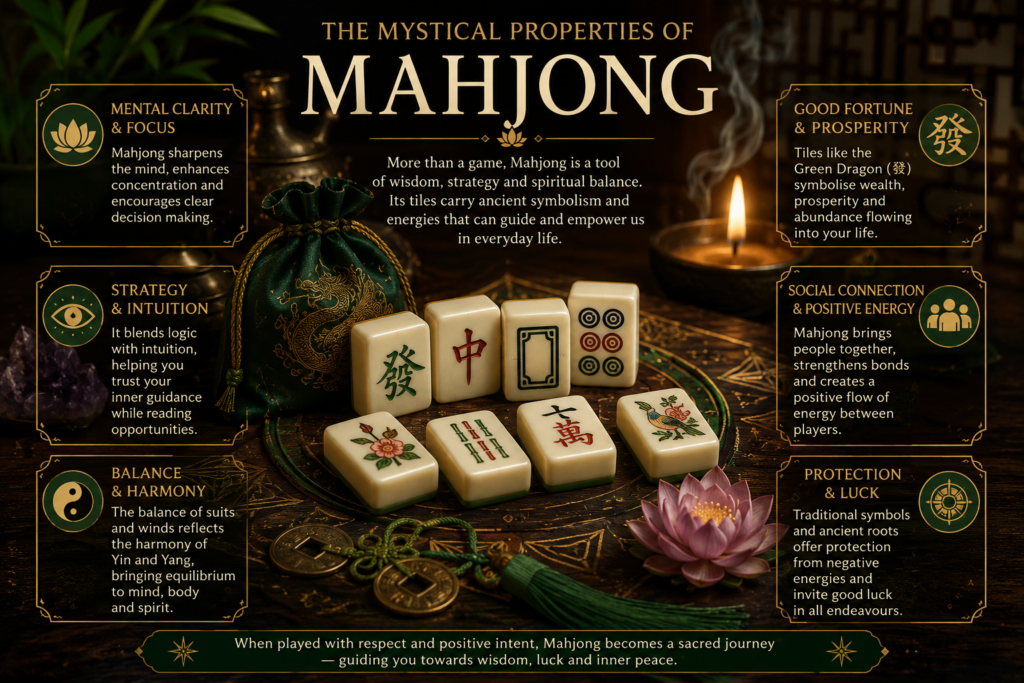
Whether played as a casual social pastime, a high-stakes competitive sport, or a tool for family bonding, Mahjong is far more than a game of matching tiles. It is a cultural cornerstone, a living map of Chinese cosmology, and a practice deeply intertwined with luck, health, and philosophy.
1. The History of Mahjong
Unlike popular myths claiming the game was invented by Confucius, Mahjong is a relatively modern creation. It emerged in the mid-19th century (around the 1850s) in the Yangtze River Delta region, specifically around Ningbo and Shanghai, during the late Qing Dynasty.
It evolved from ancient card and domino games, most notably a Ming Dynasty draw-and-discard card game called Madiao (馬吊). Artisans adapted the card suits into physical, satisfyingly tactile tiles carved from bone and bamboo. Originally a game of the elite and wealthy merchants, it quickly spread across all social classes by the early 20th century.
In the 1920s, the game was exported to the West by figures like Joseph Park Babcock, sparking a massive global craze. It became an incredibly vital social and cultural ritual for various global communities, notably becoming a staple of Jewish-American women’s social lives and evolving into “American Mahjong”.
2. Spiritual & Psychological Benefits
In traditional Chinese thought, Mahjong is viewed as a practical lesson in Yin and Yang—the pursuit of harmony amid chaos and constant change.
- Mindfulness and Zen: The physical act of washing, stacking, and discarding tiles has a rhythmic, meditative quality. To play well, a player must be fully grounded in the present moment, practising “active letting go” whenever a desired tile is discarded by an opponent.
- Emotional Resilience (Taoist Balance): The game teaches players to accept the flow of luck. You cannot control the tiles you draw, only how you react to them. It trains the mind in patience, adaptability, and emotional composure through both triumph and setback.
- Community and Connection: Spiritually, the “clatter of the sparrows” (the sound of tiles shuffling) represents the gathering of community. It fosters intergenerational bonding, breaking down social isolation and creating a shared space of laughter, strategy, and collective energy.
3. The Cosmology of the Tiles
The complete set of Mahjong tiles mirrors the harmony of the universe, rooted deeply in Chinese cultural symbolism and Taoist philosophy:
The Three Dragons (The Arrow Tiles)
In Chinese, these are not called “dragons” but Arrows (箭, jiàn), originating from archery terminology and represent the three great forces of the cosmos (the San Cai, or Three Powers):
- Red Dragon (中 – Zhong): Means “Center” or “Middle”. It represents Earth (and humanity’s place in it), symbolising the target hit in archery, achieving goals, and balance.
- Green Dragon (發 – Fa): Means “to strike it rich” or “to emit”. It represents Heaven (and the dynamic force of growth, spring, and prosperity).
- White Dragon (白 – Bai): Represents Man (specifically the Confucian virtue of purity and filial piety, or a complete miss in archery—leaving the slate clean and free of corruption). It is often represented as a blank tile or a tile with a simple border.
The Winds
The Winds represent the four cardinal directions and map to the Taoist cycle of the seasons and elemental energies:
- East Wind (東): The starting point. It represents Spring, the Wood element, and new beginnings.
- South Wind (南): Represents Summer, the Fire element, warmth, and growth.
- West Wind (西): Represents Autumn, the Metal element, harvest, and maturity.
- North Wind (北): Represents Winter, the Water element, reflection, and cold.
The Suits
The three main suits actually trace back to ancient monetary denominations used in China:
- Bamboos (索 – Suo): Originally represented strings of copper cash coins tied together in bundles. Over time, Western exporters mistook the physical knots on the money strings for bamboo shoots. In Chinese culture, bamboo represents resilience, flexibility, and integrity. The 1-Bamboo is famously depicted as a sparrow or peacock, symbolizing aspiration and freedom.
- Circles/Dots (筒 – Tong): Represent the individual copper coins themselves. Geometrically, the circle represents completeness, the cycle of life, and the pursuit of wholeness.
- Characters (萬 – Wan): Represent “Myriad” or 10,000 coins. This suit represents prosperity, human culture, and the vastness of the Chinese numeric system.
4. The Era of the Ban: China Outlaws Mahjong
During the mid-20th century, Mahjong faced a major political reckoning.
Following the establishment of the People’s Republic of China in 1949, the communist government under Mao Zedong officially banned Mahjong along with all forms of gambling. The regime viewed the game as a symbol of bourgeois decadence, capitalist corruption, and a waste of societal productivity (as games were often accompanied by opium smoking and heavy betting).
During the Cultural Revolution (1966–1976), the ban was strictly enforced. Mahjong was declared one of the “Four Olds” (Old Customs, Old Culture, Old Habits, and Old Ideas) that needed to be eradicated. Millions of antique, hand-carved bone and bamboo sets were seized and publicly burned.
It wasn’t until 1985 that the ban was officially lifted. The government realised that the game was too deeply woven into the cultural fabric to destroy. It was revived with a caveat: the state encouraged it as a healthy, non-gambling “mind sport”. In 1998, the State Sports Commission of China even published an official, standardised set of rules to separate the game’s strategic depth from its gambling associations.
5. Neurology & Dementia Prevention
Modern clinical neuroscience has confirmed what East Asian families have believed for generations: Mahjong is an exceptional cognitive workout.
- The Cognitive Demands: A typical hand of Mahjong requires a massive cognitive load. It demands rapid pattern recognition, short-term working memory (keeping track of discarded tiles), spatial reasoning, mathematical probability, and tactical decision-making under pressure.
- Neuroplasticity and Dementia: Studies published in various neurological and geriatric journals indicate that playing Mahjong regularly preserves cognitive function and delays the onset of dementia in older adults. It exercises the brain’s executive functioning center (the prefrontal cortex).
- Tactile and Motor Therapy: Shuffling, feeling, and quickly sorting the physical tiles stimulates fine motor skills and tactile receptors in the hands, keeping neural pathways between the hands and the brain highly active.
- Anti-Depressive Effects: Because Mahjong is inherently social and played in groups of four, it triggers the release of oxytocin and dopamine, significantly reducing the loneliness, anxiety, and depression that often accelerate cognitive decline in the elderly.
6. Mahjong Superstitions, Taboos, & Lucky Charms
At any serious Mahjong table, the atmosphere is thick with psychological warfare and superstitions:
- The Red Underwear: Borrowed from casino gambling culture, wearing red underwear is believed to stimulate “wealth luck” and invite positive Chi. Many players will also wear red clothing or gold accessories to attract prosperity.
- Washing Hands to Shift Luck: If a player is on a terrible losing streak, they will often excuse themselves to the bathroom to wash their hands—a literal and symbolic act to “wash away” bad luck and reset their energy.
- The Taboo of Touching Shoulders: Never touch a Mahjong player’s shoulder while they are playing. It is believed that a person’s luck resides in the shoulders; patting them “extinguishes” the flame of their good fortune.
- Books are Banned: The Chinese word for “book” (書 – shū) is a homophone for the word “to lose” (輸 – shū). Consequently, players will absolutely refuse to look at, carry, or have a book near the Mahjong table.
- Unlucky Clothing: Wearing entirely brand-new clothes to a match is considered taboo because the garments carry “untested energy”. Open-toed shoes are also discouraged by some, as they believe the luck will slip right through the toes.
7. Mahjong Feng Shui & Kua Numbers
In Feng Shui, the arrangement of the table and where you sit can determine whether you tap into the flowing currents of wealth or step into stagnant, draining energy.
What is a Kua Number and How to Calculate It?
A Kua Number (or Ming Gua) is a personal energetic code based on the Eight Mansions school of Feng Shui. Calculated using your birth year and gender, it determines your highly personal auspicious (lucky) and inauspicious (unlucky) directions.
How to Calculate Your Kua Number
Follow this step-by-step formula using your birth year (note: if you were born before the Lunar New Year—usually falling in January or early February—use the previous calendar year):
- Get your Kua Factor: Add the last two digits of your birth year. If the sum is a double digit, add those digits together until you get a single digit.
- Example (1985): $8 + 5 = 13$ $\rightarrow$ $1 + 3 = \mathbf{4}$
- Apply the Gender & Century Adjustment:
- Males born BEFORE 2000: Subtract your Kua Factor from 10.
- Example (1985 Male): $10 – 4 = \mathbf{6}$ (Kua 6)
- Females born BEFORE 2000: Add 5 to your Kua Factor. If the result is a double digit, reduce it to a single digit.
- Example (1985 Female): $4 + 5 = \mathbf{9}$ (Kua 9)
- Males born IN OR AFTER 2000: Subtract your Kua Factor from 9.
- Females born IN OR AFTER 2000: Add 6 to your Kua Factor. (Reduce to a single digit if necessary).
- Males born BEFORE 2000: Subtract your Kua Factor from 10.
(Note: In Feng Shui, if your final calculation results in a 5, males default to Kua 2, and females default to Kua 8).
Auspicious vs. Inauspicious Directions
Once you calculate your Kua number, you fall into either the East Group (Kua 1, 3, 4, 9) or the West Group (Kua 2, 6, 7, 8). When sitting at the Mahjong table, you want to face one of your auspicious directions to draw in wealth energy (Sheng Chi).
| Kua Group | Kua Numbers | Best Wealth Direction to Face (Sheng Chi) | Worst Direction to Avoid Facing (Jue Ming / Total Loss) |
| East Group | 1 | Southeast | Southwest |
| 3 | South | West | |
| 4 | North | Northeast | |
| 9 | East | Northwest | |
| West Group | 2 | Northeast | North |
| 6 | West | South | |
| 7 | Northwest | East | |
| 8 | Southwest | Southeast |
General Mahjong Feng Shui Table Rules
Beyond personal directions, players follow universal physical rules when setting up a room:
- Avoid Sitting with Your Back to a Door or Window: This is called “leaking luck.” If your back is to an opening, your wealth energy easily slips out of the room, and you cannot see “threats” approaching behind you.
- Avoid Overhead Beams: Sitting directly beneath an exposed ceiling beam creates heavy, crushing energy, suppressing your mental clarity and luck.
- The “Backing” Support: The ideal seat has a solid wall directly behind the player, acting as a mountain of support.
Mahjong frequently asked questions
How many tiles are in a standard Mahjong set?
A: A standard Chinese Mahjong set contains 144 tiles. This includes:
- 108 Suit Tiles: 36 Bamboos, 36 Circles, and 36 Characters (numbered 1 through 9, with 4 duplicates of each).
- 28 Honor Tiles: 16 Winds (4 of each direction) and 12 Dragons (4 of each color).
- 8 Flower and Season Tiles: Optional tiles used for bonus points. (Note: American Mahjong sets typically include an additional 8 “Joker” tiles, bringing the total to 152).
How many players do you need?
Traditionally, Mahjong is strictly a 4-player game. Each player represents one of the four cardinal winds (East, South, West, and North). While 3-player variants exist (highly popular in Japan and Korea), the core strategic dynamics of the game are designed around four players.
What is the main objective of the game?
A: The goal is to build a complete winning hand of 14 tiles (usually consisting of four sets of three and one matching pair). The sets of three can be:
- Chow: A run of three consecutive numbers in the same suit (e.g., 4-5-6 of Circles).
- Pung: Three of the exact same tile (e.g., three Red Dragons).
- Kong: Four of the exact same tile (acts functionally as a set of three, requiring a replacement tile drawn to keep your hand size correct).
Gameplay & Rules
What is the difference between “Chinese” and “American” Mahjong?
A: The differences are substantial:
- Chinese Mahjong: Focuses on speed, traditional card-like hands (runs and triplets), and uses 144 tiles. It relies heavily on tactical flexibility.
- American Mahjong: Requires the use of an annually published National Mahjongg League (NMJL) card that list specific, complex winning hands. It uses 152 tiles (adding Jokers) and includes a pre-game tile-swapping phase called the “Charleston.”
Strategy & Etiquette
What is a “discard pile error” or “throwing a hot tile”?
If you discard a tile late in the game that another player uses to declare “Mahjong,” you are said to have thrown a “hot tile” (or paying the shooter). In many traditional rule sets, the player who discards the winning tile must pay the entire loss for the rest of the table, rather than splitting the loss evenly.
What does “Wall Fishing” or “Self-Draw” mean?
A: Winning by “Self-Draw” (自摸 – Zimo) means you drew the final winning tile yourself directly from the wall, rather than claiming another player’s discard. This is highly coveted because it increases your score and forces all three opponents to pay you equally, rather than just the single person who discarded.
What are some basic table manners I should know?
- Name your discards: Call out the tile clearly as you place it in the centre (e.g., “Three Bamboos” or “West Wind”).
- No “ghost touching”: Once you touch a tile from the wall on your turn, you must draw it. You cannot change your mind and put it back.
- Keep your hand hidden: Only reveal tiles that you have claimed via Chow, Pung, or Kong. The rest of your hand must remain standing up facing you.