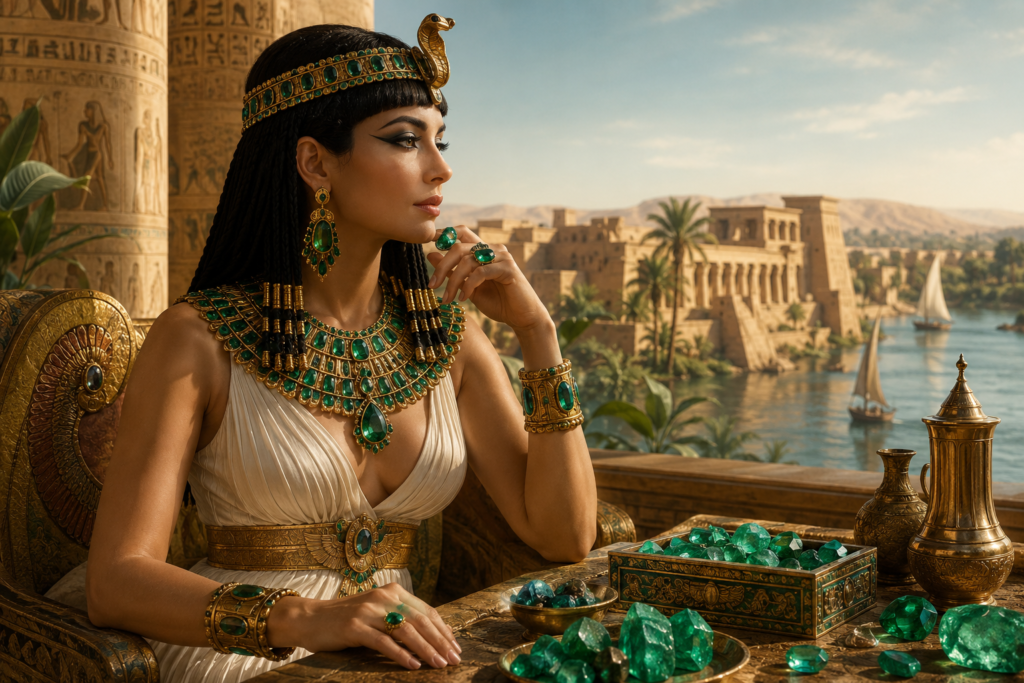
For thousands of years, the shimmering green fire of the emerald has held humanity spellbound, serving as the ultimate emblem of wealth, power, and divine favour. Long before the breathtaking, highly saturated gemstones of Colombia were introduced to the global stage, the ancient world looked to a single, desolate region in the Eastern Desert of Egypt to supply its royal courts. Nestled within the sun-scorched, rugged peaks near the Red Sea lay the legendary Mons Smaragdus (Emerald Mountain) These became Cleopatra’s Emerald Mines whom had an obsession with the green Jewel. The location of the mines were lost over time until their rediscovery in the nineteenth-century.
Cleopatra’s Obsession: Sovereign Adornments & Royal Power
While emeralds were mined in Egypt centuries before her rise to power, no historical figure is more intrinsically linked to the “green gem” than Queen Cleopatra VII. To Cleopatra, emeralds were far more than magnificent pieces of jewellery; they were political instruments of the highest order.
In the ancient world, the vibrant, renewing green of the emerald was associated with fertility, rebirth, and the eternal life-giving waters of the Nile. Cleopatra utilised this rich cultural symbolism to consolidate her status as a living goddess. She claimed exclusive ownership of the Egyptian mines, transforming them into a state-run monopoly and declaring all extracted crystals as imperial property.
Cleopatra famously draped herself in massive, polished emeralds to project raw authority during diplomatic negotiations with Rome. Rather than faceted gems (as modern cutting techniques did not yet exist), her jewellery featured large, smooth, tumbled stones or natural hexagonal crystals strung into heavy golden collars, tiaras, and armlets. In a grand display of patronage, she had her own likeness engraved onto high-grade emeralds, presenting these personalised talismans to favoured Roman generals and foreign ambassadors as the ultimate gesture of royal favour.
Mons Smaragdus: The Legendary Emerald Mountain
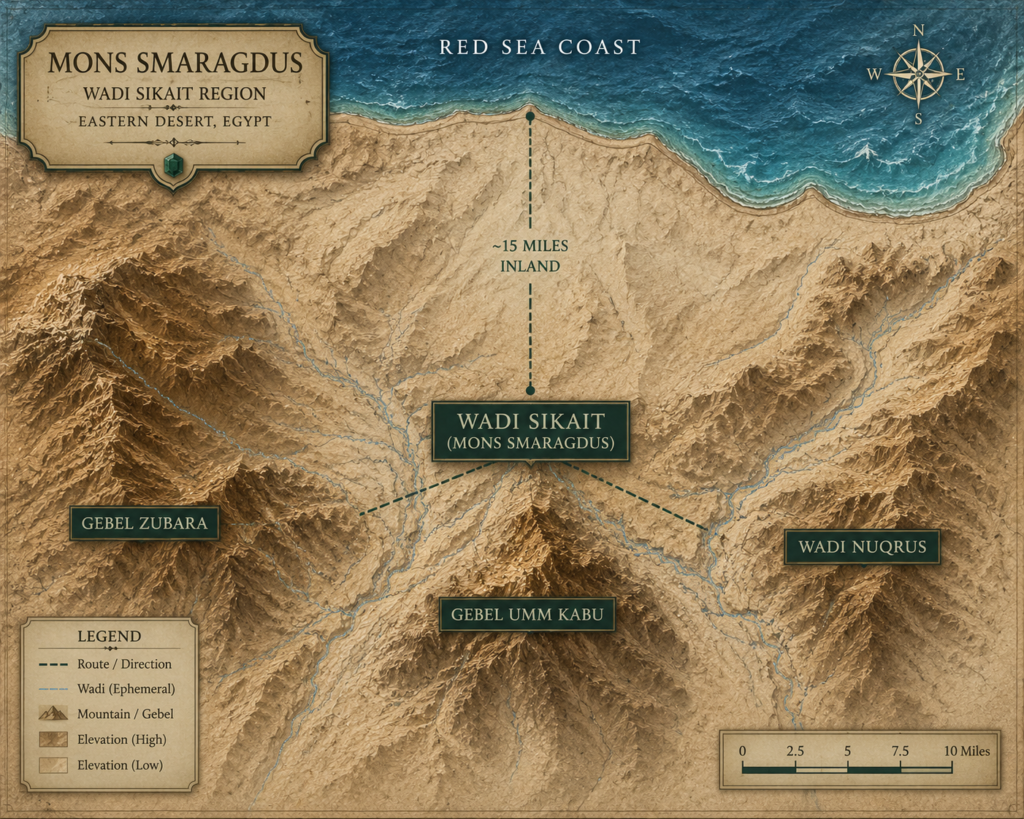
The ancient mining district of Mons Smaragdus (Latin for “Emerald Mountain”) is located in the mountain valley of Wadi Sikait, in Egypt’s Eastern Desert, roughly fifteen miles from the Red Sea coast.
This forbidding, hyper-arid landscape is home to the oldest known emerald mining complex in human history. Archaeological surveys indicate that while minor prospecting may have occurred earlier, systematic mining began during the Ptolemaic period (330 BC to 30 BC). However, it was under Roman administration that the mines reached their absolute peak of industrial output. The Romans built fortified settlements, watchtowers, temples, and an extensive network of roads to transport the precious cargo across the desert to Coptos on the Nile, from where they were shipped across the entire Mediterranean basin.
Ancient Engineering: Ptolemaic and Roman Mining Techniques
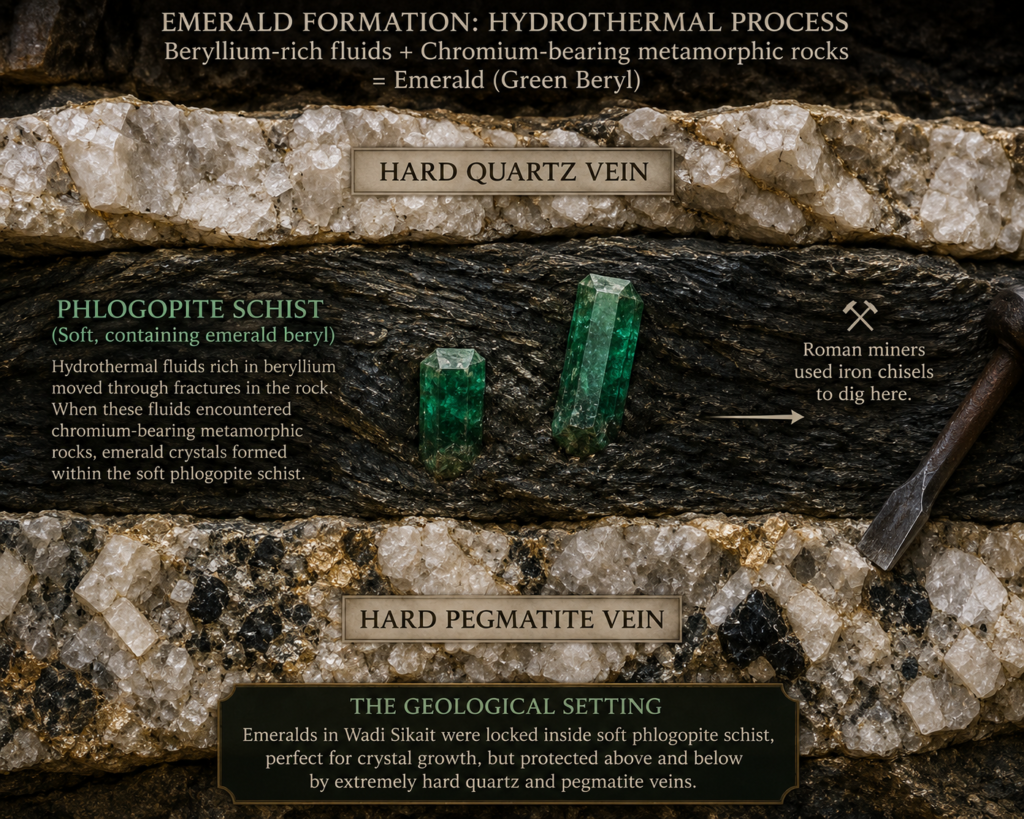
Extracting emeralds from the harsh mountain rock was an extraordinary feat of ancient engineering, achieved through sheer human labour and primitive but effective tools.
Geologically, emeralds form in hydrothermal veins where beryllium-rich fluids interact with chromium-bearing metamorphic rocks. In Wadi Sikait, these precious crystals were locked inside a soft, dark rock known as phlogopite schist, which was itself flanked by incredibly hard quartz and pegmatite veins.
The Mining Methods:
- Open-Cut Trenches: Initial operations began on the surface. Miners excavated shallow, open trenches up to several meters deep, following the visible veins of glittering quartz and pegmatite.
- Subterranean Shafts: Once the surface deposits were exhausted, miners followed the veins deep underground. They carved out vertical shafts and narrow, tortuous tunnels that plummeted up to 900 feet into the earth.
- The “Creep” Galleries: Many of these subterranean passages were incredibly primitive and narrow. Miners often had to crawl or slide flat on their bellies through labyrinthine passages just wide enough to squeeze a human body through.
- Excavation Tools: Tool marks left in the rock reveal that ancient miners relied on flat-edged iron chisels and pointed iron picks to chip away at the soft schist. The harder quartz veins were left intact as “pillars” to support the roofs of the caverns and prevent catastrophic collapses.
Work in the dark, hot, and dust-choked galleries was brutal. Miners worked by the dim, flickering light of clay oil lamps, physically hauling heavy baskets of crushed schist up to the surface to be meticulously hand-washed and sorted for emerald beryl.
Pliny the Elder’s Observations: The Healing Power of the Green Ray
The unique allure of Egyptian emeralds did not escape the notice of classical scholars. Gaius Plinius Secundus, known historically as Pliny the Elder, dedicated a significant portion of Book XXXVII of his famous encyclopedic work, Naturalis Historia, to the virtues of the emerald (smaragdus).
Pliny noted that while other gemstones could fatigue the eyes, the lush, soothing green of the emerald had a uniquely restorative effect on human vision. He wrote:
“Indeed, no color is more pleasing to the eye than green… after straining our eyes by looking at other objects, our sight is refreshed and rested by turning to this stone.”
This observation was not merely theoretical; it was highly practical. Pliny recorded that ancient gem-engravers—who spent gruelling hours carving intricate designs into hard stones under poor light—would keep raw emeralds on their workbenches to gaze upon, using the gemstone’s gentle “green ray” to soothe and heal their strained eyes.
Even more famously, Pliny documented that the eccentric Roman Emperor Nero would watch gladiatorial combats through a large, flat, polished emerald. While historians still debate whether Nero used the stone as a corrective monocle, a mirror, or simply as a protective sun-shield to filter out the harsh glare of the Roman sun, the legend firmly cemented the emerald’s ancient reputation as a protector of physical sight.
Lost to the Desert: The Long Silence
Following the decline of the Roman and Byzantine empires, the mining operations at Mons Smaragdus slowly ground to a halt. By the Middle Ages, the rise of powerful Islamic dynasties and shifting trade routes caused the remote desert settlements to be entirely abandoned.
The final blow to the Egyptian mines came in the sixteenth century, when Spanish conquistadors discovered the vast, geometrically perfect, and astonishingly vibrant emerald deposits of Muzo and Chivor in Colombia. The superior quality and abundance of Colombian emeralds flooded the global market, completely eclipsing the historic, heavily included Egyptian beryl.
Over the centuries, the shifting sands of the Eastern Desert swallowed the roads, temples, and watchtowers of Mons Smaragdus. The exact location of Cleopatra’s legendary mines passed from living memory, surviving only as a myth whispered in classical texts.
The 19th-Century Rediscovery: Frédéric Cailliaud’s Descent
For nearly five hundred years, the desert successfully guarded its secret. That was until autumn of 1817, when a young, tenacious French explorer and mineralogist named Frédéric Cailliaud set foot in Egypt.
Initially hired by the Egyptian viceroy to search for commercial sulphur deposits, Cailliaud was a trained jeweller with an enduring passion for mineralogy and ancient history. Armed with clues from Pliny the Elder’s writings, Cailliaud suspected that the legendary ancient emerald mines were hidden somewhere in the desolate mountains between the Nile and the Red Sea.
Discovery
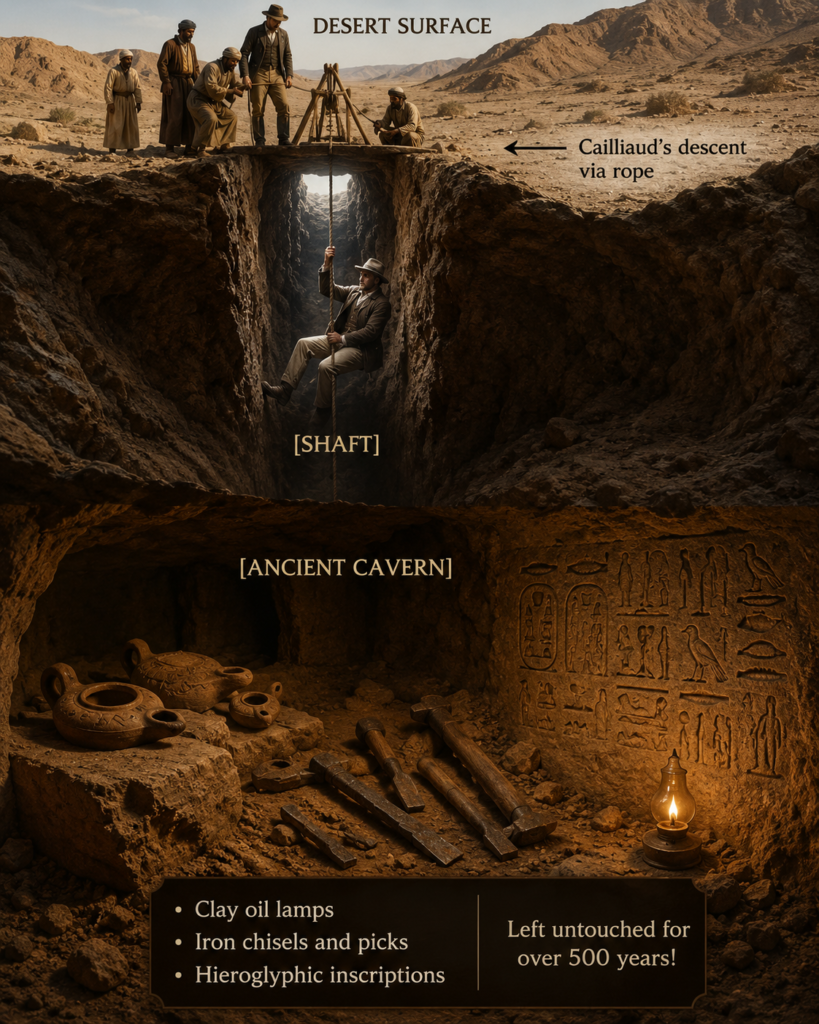
On November 22, 1817, near the dry valley of Wadi Sikait, Cailliaud spotted a deep, artificially carved shaft plunging into the earth. Braving a highly dangerous and unstable descent, Cailliaud had himself lowered by rope into the dark, yawning cavern. What he found at the bottom was a breathtaking time capsule. Sealed away from the elements, the subterranean chambers lay exactly as they had been left when abandoned centuries prior:
- Archaic Tools: Scattered across the cavern floors were the original iron picks, crowbars, and chisels used by Roman miners.
- Ropes & Baskets: Woven fibre ropes and hauling baskets lay preserved by the dry desert air.
- Clay Lamps: Primitive oil lamps, some still stained with ancient soot, rested on rock ledges where miners had placed them over fifteen hundred years ago.
- Ancient Inscriptions: Carved directly into the rock walls, Cailliaud identified Greek inscriptions dating to the Hellenistic period and ancient hieroglyphs, proving the mines had been worked across multiple millennia.
Cailliaud meticulously mapped the vast underground network, revealing that the interconnected galleries ran for nearly ten miles. Upon returning to the surface, he discovered the ruins of a sprawling miner’s village, intact watchtowers, and a paved ancient road leading directly to the abandoned wharves of the Red Sea. Thanks to Cailliaud’s daring exploration, the legendary mines of Cleopatra were restored to the pages of history.
💡 Internal Linking Strategy
To build a highly cohesive, high-performing SEO content cluster, be sure to strategically link this historical deep-dive back to your Emerald Pillar Guide:
- Anchor Text Opportunity: When referencing the geological makeup of the mines, link to your main article using descriptive anchor text: “…to understand the unique geology of these specimen-grade stones, read our breakdown on [natural emerald gemstone science and composition].”
- Folklore and Metaphysical Link: Connect Pliny the Elder’s ocular healing observations back to the main guide: “…this historical connection to eye-healing directly paved the way for modern metaphysical associations with the [emerald heart chakra connection] and spiritual clarity.”
These are my personally selected and curated Emerald products